


Page 159 - Materials Chemistry, Second Edition
P. 159
Ch004-P373623.qxd  3/26/07  4:46 PM  Page 138
                     Sustainable Industrial Design and Waste Management
                138
                with its own auditing procedure. The information gathered from auditing is
                used to perform a gap analysis to determine whether the goals have been
                met. The main goal is compliance with regulations, which will finally lead
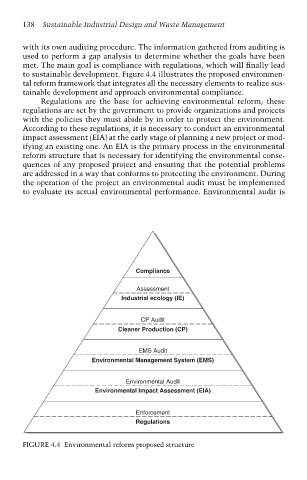
                to sustainable development. Figure 4.4 illustrates the proposed environmen-
                tal reform framework that integrates all the necessary elements to realize sus-
                tainable development and approach environmental compliance.
                     Regulations are the base for achieving environmental reform; these
                regulations are set by the government to provide organizations and projects
                with the policies they must abide by in order to protect the environment.
                According to these regulations, it is necessary to conduct an environmental
                impact assessment (EIA) at the early stage of planning a new project or mod-
                ifying an existing one. An EIA is the primary process in the environmental
                reform structure that is necessary for identifying the environmental conse-
                quences of any proposed project and ensuring that the potential problems
                are addressed in a way that conforms to protecting the environment. During
                the operation of the project an environmental audit must be implemented
                to evaluate its actual environmental performance. Environmental audit is


                                              Compliance

                                              Assessment
                                          Industrial ecology (IE)

                                                CP Audit
                                          Cleaner Production (CP)

                                               EMS Audit
                                   Environmental Management System (EMS)


                                            Environmental Audit
                                   Environmental Impact Assessment (EIA)


                                              Enforcement
                                              Regulations


                FIGURE 4.4 Environmental reform proposed structure

