


Page 176 -
P. 176
ChaPter 5  •  InformatIon GatherInG: unobtrusIve methods     143

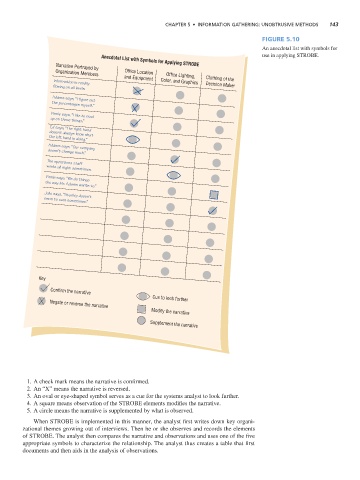
                                                                                                Figure 5.10
                                                                                                An anecdotal list with symbols for
                                                                                                use in applying STROBE.
                            Narrative Portrayed by  Anecdotal List with Symbols for Applying STROBE
                                                   Office Location
                            Organization Members
                                                                 Office Lighting,
                                                   and Equipment              Clothing of the
                                                               Color, and Graphics
                           Information is readily
                                                                              Decision Maker
                           flowing on all levels.
                           Adams says, “I figure out
                           the percentages myself.”
                           Vinnie says, “I like to read
                          up on these things.”
                          Ed says, “The right hand
                          doesn’t always know what
                          the left hand is doing.”
                          Adams says, “Our company
                          doesn’t change much.”
                         The operations staff
                         works all night sometimes.

                         Vinnie says, “We do things
                         the way Mr. Adams wants to.”
                        Julie says, “Stanley doesn’t
                        seem to care sometimes.”


                      Key

                          Confirm the narrative
                                                            Cue to look further
                          Negate or reverse the narrative
                                                            Modify the narrative

                                                           Supplement the narrative


                   1. A check mark means the narrative is confirmed.
                   2. An “X” means the narrative is reversed.
                   3. An oval or eye-shaped symbol serves as a cue for the systems analyst to look further.
                   4. A square means observation of the STROBE elements modifies the narrative.
                   5. A circle means the narrative is supplemented by what is observed.
                     When STROBE is implemented in this manner, the analyst first writes down key organi-
                 zational themes growing out of interviews. Then he or she observes and records the elements
                 of STROBE. The analyst then compares the narrative and observations and uses one of the five
                 appropriate symbols to characterize the relationship. The analyst thus creates a table that first
                 documents and then aids in the analysis of observations.

