


Page 208 - The Art of Designing Embedded Systems
P. 208
People Musings  195


                     (for example, schedule slippages due to changing specs), then these should
                     be coldly, accurately documented in a form that’s useful to all involved.
                     No whining allowed.
                          No, a successful postmortem is an unemotional, nonconfrontational,
                     reasoned, thoughtful process. It works when all participants buy into the
                     idea that improvement is important and possible.
                          I feel that a successful postmortem results in a written document that
                     will be preserved with other engineering materials, perhaps in a drawing
                     system. The document is important, as it’s a formal analysis of ways of
                     doing engineering better. Just as a contract is a written version of an infor-
                     mal understanding, the postmortem report codifies the information.
                          A great postmortem results in a report that’s eminently readable, that
                     even people not involved with the project can understand. File these to-
                     gether and give them to all new hires to give them “virtual experience.”
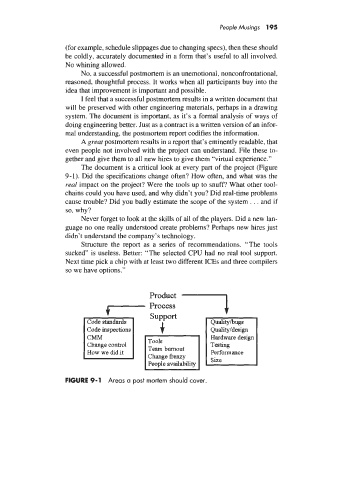
                          The document is a critical look at every part of the project (Figure
                     9-1). Did the specifications change often? How often, and what was the
                     real impact on the project? Were the tools up to snuff? What other tool-
                     chains could you have used, and why didn’t you? Did real-time problems
                     cause trouble? Did you badly estimate the scope of the system. . . and if
                     so, why?
                          Never forget to look at the skills of all of the players. Did a new lan-
                     guage no one really understood create problems? Perhaps new hires just
                     didn’t understand the company’s technology.
                          Structure the  report  as  a  series  of  recommendations.  “The tools
                     sucked” is useless. Better: “The selected CPU had  no real tool support.
                     Next time pick a chip with at least two different ICES and three compilers
                     so we have options.”


                                                        1
                                               Product


                            Code inspections                     Quahtyldesign
                                                                 Hardware design
                            Change control
                            How we did it     Team burnout       Perform mce
                                              Change frenzy
                                              People avadability


                     FIGURE 9-1  Areas a post mortem should cover

