


Page 159 - The CNN Effect in Action - How the News Media Pushed the West toward War ini Kosovo
P. 159
1403975191ts07.qxd 19-2-07 05:08 PM Page 125
125
THE KOSOVO CRISIS—THE MACRO REVIEW
ISIS—THE MA
E
Table 6.8 Continued
Week Beginning
Total
1
2
1
October 4
7
4
1
4
5
October 11
1
1
0
0
October 18
2
0
3
October 25
5
0
November 1
0
0
0
1
November 8
2
1
0
0
November 15
1
1
0
0
0
0
0
November 22
0
November 29
0
1
1
1
December 6
0
0
1
0
3
0
December 13
3
December 20
0
0
2
2
0
0
December 27
0
0
0
January 3
0
0
0
0
January 10
1
1
2
8
January 17
4
4
0
8
1
4
3
January 24
0
4
0
4
January 31
7
0
4
3
February 7
6
February 14 THE K OSO V O CR Options 2 3 CR O R 10 VIEW 125
1
8
1
February 21 3 8 0 11
February 28 0 0 0 0
March 7 3 1 0 4
March 14 2 4 1 7
March 21 0 0 6 6
Total 64 79 18 161
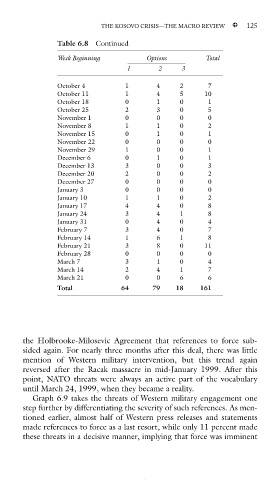
the Holbrooke-Milosevic Agreement that references to force sub-
sided again. For nearly three months after this deal, there was little
mention of Western military intervention, but this trend again
reversed after the Racak massacre in mid-January 1999. After this
point, NATO threats were always an active part of the vocabulary
until March 24, 1999, when they became a reality.
Graph 6.9 takes the threats of Western military engagement one
step further by differentiating the severity of such references. As men-
tioned earlier, almost half of Western press releases and statements
made references to force as a last resort, while only 11 percent made
these threats in a decisive manner, implying that force was imminent

