


Page 289 - The Handbook of Persuasion and Social Marketing
P. 289
Public Support for Regulating the Public                           265

                                        Who must sacrifice?
                Who is harmed/ would     Specific Segment      Most of Society
                benefit?
                                            Individual             Public
                Specific Segment
                                          Fence or Trap           Altruism
                                             Public                Social
                Most of Society
                                            Protection            Dilemma

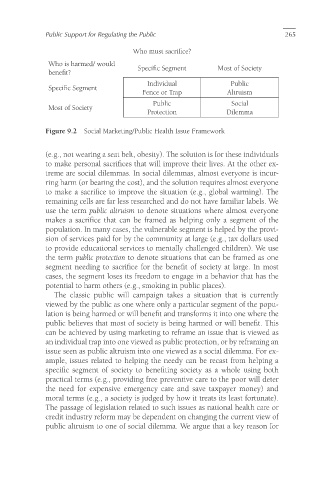
               Figure 9.2  Social Marketing/Public Health Issue Framework


               (e.g., not wearing a seat belt, obesity). The solution is for these individuals
               to make personal sacrifices that will improve their lives. At the other ex-
               treme are social dilemmas. In social dilemmas, almost everyone is incur-
               ring harm (or bearing the cost), and the solution requires almost everyone
               to make a sacrifice to improve the situation (e.g., global warming). The
               remaining cells are far less researched and do not have familiar labels. We
               use the term public altruism to denote situations where almost everyone
               makes a sacrifice that can be framed as helping only a segment of the
               population. In many cases, the vulnerable segment is helped by the provi-
               sion of services paid for by the community at large (e.g., tax dollars used
               to provide educational services to mentally challenged children). We use
               the term public protection to denote situations that can be framed as one
               segment needing to sacrifice for the benefit of society at large. In most
               cases, the segment loses its freedom to engage in a behavior that has the
               potential to harm others (e.g., smoking in public places).
                  The classic public will campaign takes a situation that is currently
               viewed by the public as one where only a particular segment of the popu-
               lation is being harmed or will benefit and transforms it into one where the
               public believes that most of society is being harmed or will benefit. This
               can be achieved by using marketing to reframe an issue that is viewed as
               an individual trap into one viewed as public protection, or by reframing an
               issue seen as public altruism into one viewed as a social dilemma. For ex-
               ample, issues related to helping the needy can be recast from helping a
               specific segment of society to benefiting society as a whole using both
               practical terms (e.g., providing free preventive care to the poor will deter
               the need for expensive emergency care and save taxpayer money) and
               moral terms (e.g., a society is judged by how it treats its least fortunate).
               The passage of legislation related to such issues as national health care or
               credit industry reform may be dependent on changing the current view of
               public altruism to one of social dilemma. We argue that a key reason for

