


Page 143 - Understanding Automotive Electronics
P. 143
2735 | CH 4  Page 130  Tuesday, March 10, 1998  11:06 AM


                4                     MICROCOMPUTER INSTRUMENTATION AND CONTROL


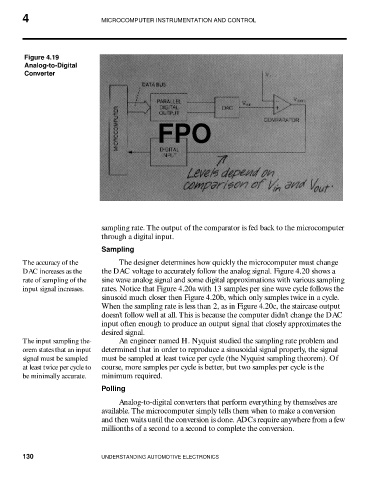
                Figure 4.19
                Analog-to-Digital
                Converter


                                                     FPO


                                      sampling rate. The output of the comparator is fed back to the microcomputer
                                      through a digital input.
                                      Sampling

                The accuracy of the       The designer determines how quickly the microcomputer must change
                DAC increases as the   the DAC voltage to accurately follow the analog signal. Figure 4.20 shows a
                rate of sampling of the   sine wave analog signal and some digital approximations with various sampling
                input signal increases.  rates. Notice that Figure 4.20a with 13 samples per sine wave cycle follows the
                                      sinusoid much closer then Figure 4.20b, which only samples twice in a cycle.
                                      When the sampling rate is less than 2, as in Figure 4.20c, the staircase output
                                      doesn’t follow well at all. This is because the computer didn’t change the DAC
                                      input often enough to produce an output signal that closely approximates the
                                      desired signal.
                The input sampling the-   An engineer named H. Nyquist studied the sampling rate problem and
                orem states that an input   determined that in order to reproduce a sinusoidal signal properly, the signal
                signal must be sampled   must be sampled at least twice per cycle (the Nyquist sampling theorem). Of
                at least twice per cycle to   course, more samples per cycle is better, but two samples per cycle is the
                be minimally accurate.  minimum required.
                                      Polling
                                          Analog-to-digital converters that perform everything by themselves are
                                      available. The microcomputer simply tells them when to make a conversion
                                      and then waits until the conversion is done. ADCs require anywhere from a few
                                      millionths of a second to a second to complete the conversion.


                130                   UNDERSTANDING AUTOMOTIVE ELECTRONICS

