


Page 509 - Materials Chemistry, Second Edition
P. 509
CAT3525_C15.qxd  1/27/2005  12:40 PM  Page 480
                       480                       Waste Management Practices: Municipal, Hazardous, and Industrial
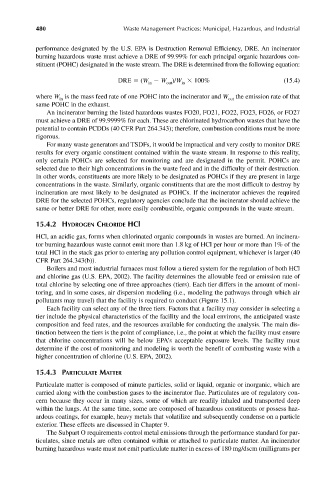
                       performance designated by the U.S. EPA is Destruction Removal Efficiency, DRE. An incinerator
                       burning hazardous waste must achieve a DRE of 99.99% for each principal organic hazardous con-
                       stituent (POHC) designated in the waste stream. The DRE is determined from the following equation:

                                               DRE   (W   W )/W   100%                           (15.4)
                                                                  in
                                                              out
                                                        in
                       where W is the mass feed rate of one POHC into the incinerator and W out  the emission rate of that
                              in
                       same POHC in the exhaust.
                          An incinerator burning the listed hazardous wastes FO20, FO21, FO22, FO23, FO26, or FO27
                       must achieve a DRE of 99.9999% for each. These are chlorinated hydrocarbon wastes that have the
                       potential to contain PCDDs (40 CFR Part 264.343); therefore, combustion conditions must be more
                       rigorous.
                          For many waste generators and TSDFs, it would be impractical and very costly to monitor DRE
                       results for every organic constituent contained within the waste stream. In response to this reality,
                       only certain POHCs are selected for monitoring and are designated in the permit. POHCs are
                       selected due to their high concentrations in the waste feed and in the difficulty of their destruction.
                       In other words, constituents are more likely to be designated as POHCs if they are present in large
                       concentrations in the waste. Similarly, organic constituents that are the most difficult to destroy by
                       incineration are most likely to be designated as POHCs. If the incinerator achieves the required
                       DRE for the selected POHCs, regulatory agencies conclude that the incinerator should achieve the
                       same or better DRE for other, more easily combustible, organic compounds in the waste stream.

                       15.4.2 HYDROGEN CHLORIDE HCl
                       HCl, an acidic gas, forms when chlorinated organic compounds in wastes are burned. An incinera-
                       tor burning hazardous waste cannot emit more than 1.8 kg of HCl per hour or more than 1% of the
                       total HCl in the stack gas prior to entering any pollution control equipment, whichever is larger (40
                       CFR Part 264.343(b)).
                          Boilers and most industrial furnaces must follow a tiered system for the regulation of both HCl
                       and chlorine gas (U.S. EPA, 2002). The facility determines the allowable feed or emission rate of
                       total chlorine by selecting one of three approaches (tiers). Each tier differs in the amount of moni-
                       toring, and in some cases, air dispersion modeling (i.e., modeling the pathways through which air
                       pollutants may travel) that the facility is required to conduct (Figure 15.1).
                          Each facility can select any of the three tiers. Factors that a facility may consider in selecting a
                       tier include the physical characteristics of the facility and the local environs, the anticipated waste
                       composition and feed rates, and the resources available for conducting the analysis. The main dis-
                       tinction between the tiers is the point of compliance, i.e., the point at which the facility must ensure
                       that chlorine concentrations will be below EPA’s acceptable exposure levels.  The facility must
                       determine if the cost of monitoring and modeling is worth the benefit of combusting waste with a
                       higher concentration of chlorine (U.S. EPA, 2002).

                       15.4.3 PARTICULATE MATTER
                       Particulate matter is composed of minute particles, solid or liquid, organic or inorganic, which are
                       carried along with the combustion gases to the incinerator flue. Particulates are of regulatory con-
                       cern because they occur in many sizes, some of which are readily inhaled and transported deep
                       within the lungs. At the same time, some are composed of hazardous constituents or possess haz-
                       ardous coatings, for example, heavy metals that volatilize and subsequently condense on a particle
                       exterior. These effects are discussed in Chapter 9.
                          The Subpart O requirements control metal emissions through the performance standard for par-
                       ticulates, since metals are often contained within or attached to particulate matter. An incinerator
                       burning hazardous waste must not emit particulate matter in excess of 180 mg/dscm (milligrams per

