


Page 242 - Water and Wastewater Engineering Design Principles and Practice
P. 242
COAGULATION AND FLOCCULATION 6-19

          Jar test II

                                                      Jar numbers
                               1          2         3          4          5         6
           pH                  6.0        6.0       6.0        6.0       6.0        6.0
           Alum dose (mg/L)    5          7         10         12        15         20
           Turbidity (NTU)     14         9.5       5          4.5       6          13

            Solution:
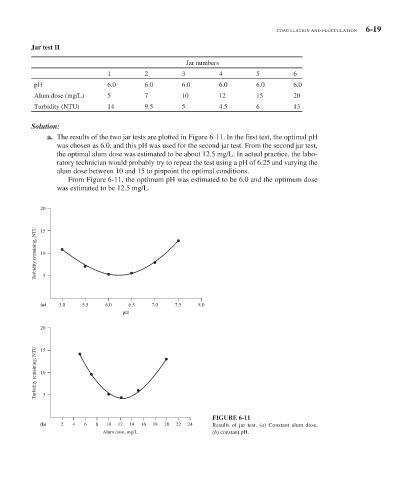
                a.  The results of the two jar tests are plotted in  Figure 6-11 . In the first test, the optimal pH
                 was chosen as 6.0, and this pH was used for the second jar test. From the second jar test,
                 the optimal alum dose was estimated to be about 12.5 mg/L. In actual practice, the labo-
                 ratory technician would probably try to repeat the test using a pH of 6.25 and varying the
                 alum dose between 10 and 15 to pinpoint the optimal conditions.
                    From  Figure 6-11 , the optimum pH was estimated to be 6.0 and the optimum dose
                 was estimated to be 12.5 mg/L.


            20

           Turbidity remaining, NTU  15 5


            10


            (a)   5.0   5.5    6.0   6.5    7.0    7.5   8.0
                                    pH

            20


           Turbidity remaining, NTU  10 5
            15


                                                             FIGURE 6-11
            (b)   2   4  6  8  10  12  14  16  18  20  22  24  Results of jar test. (a) Constant alum  dose,
                              Alum dose, mg/L                (b) constant pH.

