


Page 166 - Encyclopedia of the Unusual and Unexplained Vol. 3
P. 166
Mysteries of the Mind                                                                         147


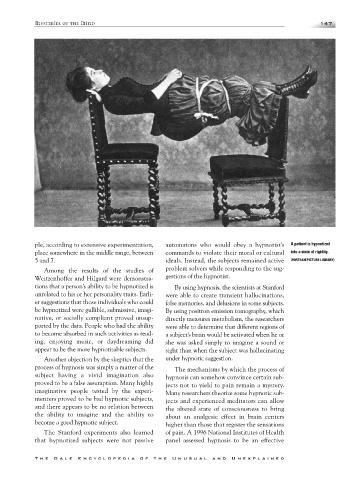
             ple, according to extensive experimentation,  automatons who would obey a hypnotist’s  A patient is hypnotized
             place somewhere in the middle range, between  commands to violate their moral or cultural  into a state of rigidity.
             5 and 7.                                   ideals. Instead, the subjects remained active  (FORTEAN PICTURE LIBRARY)
                Among the results of the studies of     problem solvers while responding to the sug-
             Weitzenhoffer and Hilgard were demonstra-  gestions of the hypnotist.
             tions that a person’s ability to be hypnotized is  By using hypnosis, the scientists at Stanford
             unrelated to his or her personality traits. Earli-  were able to create transient hallucinations,
             er suggestions that those individuals who could  false memories, and delusions in some subjects.
             be hypnotized were gullible, submissive, imagi-  By using positron emission tomography, which
             native, or socially compliant proved unsup-  directly measures metabolism, the researchers
             ported by the data. People who had the ability  were able to determine that different regions of
             to become absorbed in such activities as read-  a subject’s brain would be activated when he or
             ing, enjoying music, or daydreaming did    she was asked simply to imagine a sound or
             appear to be the more hypnotizable subjects.  sight than when the subject was hallucinating
                Another objection by the skeptics that the  under hypnotic suggestion.
             process of hypnosis was simply a matter of the  The mechanisms by which the process of
             subject having a vivid imagination also    hypnosis can somehow convince certain sub-
             proved to be a false assumption. Many highly  jects not to yield to pain remain a mystery.
             imaginative people tested by the experi-   Many researchers theorize some hypnotic sub-
             menters proved to be bad hypnotic subjects,  jects and experienced meditators can allow
             and there appears to be no relation between  the altered state of consciousness to bring
             the ability to imagine and the ability to  about an analgesic effect in brain centers
             become a good hypnotic subject.            higher than those that register the sensations

                The Stanford experiments also learned   of pain. A 1996 National Institutes of Health
             that hypnotized subjects were not passive  panel assessed hypnosis to be an effective


             The Gale Enc y clopedia of the Unusu al and Unexplained

