


Page 168 - Encyclopedia of the Unusual and Unexplained Vol. 3
P. 168
Mysteries of the Mind                                                                         149

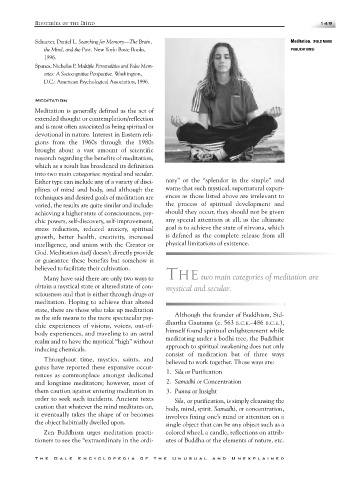
             Schacter, Daniel L. Searching for Memory—The Brain,                                 Meditation. (FIELD MARK
                the Mind, and the Past. New York: Basic Books,                                   PUBLICATIONS)
                1996.
             Spanos, Nicholas P. Multiple Personalities and False Mem-
                ories: A Sociocognitive Perspective. Washington,
                D.C.: American Psychological Association, 1996.


             Meditation
             Meditation is generally defined as the act of
             extended thought or contemplation/reflection
             and is most often associated as being spiritual or
             devotional in nature. Interest in Eastern reli-
             gions from the 1960s through the 1980s
             brought about a vast amount of scientific
             research regarding the benefits of meditation,
             which as a result has broadened its definition
             into two main categories: mystical and secular.
             Either type can include any of a variety of disci-  nary” or the “splendor in the simple” and
             plines of mind and body, and although the  warns that such mystical, supernatural experi-
             techniques and desired goals of meditation are  ences as those listed above are irrelevant to
             varied, the results are quite similar and include:  the process of spiritual development and
             achieving a higher state of consciousness, psy-  should they occur, they should not be given
             chic powers, self-discovery, self-improvement,  any special attention at all, as the ultimate
             stress reduction, reduced anxiety, spiritual  goal is to achieve the state of nirvana, which
             growth, better health, creativity, increased  is defined as the complete release from all
             intelligence, and union with the Creator or  physical limitations of existence.
             God. Meditation itself doesn’t directly provide
             or guarantee these benefits but somehow is
             believed to facilitate their cultivation.
                Many have said there are only two ways to THE two main categories of meditation are
             obtain a mystical state or altered state of con-  mystical and secular.
             sciousness and that is either through drugs or
             meditation. Hoping to achieve that altered
             state, there are those who take up meditation
             as the safe means to the more spectacular psy-  Although the founder of Buddhism, Sid-
             chic experiences of visions, voices, out-of-  dhartha Gautama (c. 563 B.C.E.–486 B.C.E.),
             body experiences, and traveling to an astral  himself found spiritual enlightenment while
             realm and to have the mystical “high” without  meditating under a bodhi tree, the Buddhist
             inducing chemicals.                        approach to spiritual awakening does not only
                                                        consist of meditation but of three ways
                Throughout time, mystics, saints, and   believed to work together. Those ways are:
             gurus have reported these expansive occur-
             rences as commonplace amongst dedicated    1. Sila or Purification
             and longtime meditators; however, most of  2. Samadhi or Concentration
             them caution against entering meditation in  3. Punna or Insight
             order to seek such incidents. Ancient texts   Sila, or purification, is simply cleansing the
             caution that whatever the mind meditates on,  body, mind, spirit. Samadhi, or concentration,
             it eventually takes the shape of or becomes  involves fixing one’s mind or attention on a
             the object habitually dwelled upon.        single object that can be any object such as a

                Zen Buddhism urges meditation practi-   colored wheel, a candle, reflections on attrib-
             tioners to see the “extraordinary in the ordi-  utes of Buddha or the elements of nature, etc.


             The Gale Enc y clopedia of the Unusu al and Unexplained

