


Page 101 - A Practical Companion to Reservoir Stimulation
P. 101
PRACTICAL COMPANION TO RESERVOIR STIMULATION


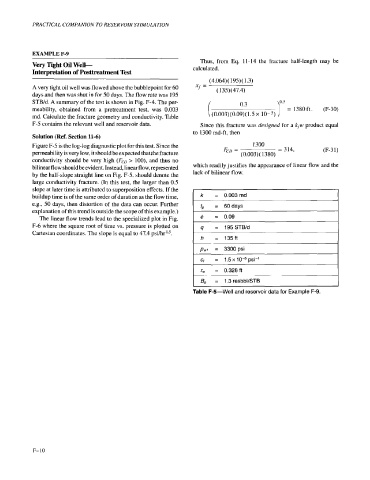
            EXAMPLE F-9
                                                                   Thus,  from  Eq.  11-14 the  fracture half-length  may  be
            Very Tight Oil Well-                                 calculated.
            Interpretation of Posttreatment Test
                                                                      (4.064)  ( 195) ( 1.3)
            A very tight oil well was flowed above the bubblepoint for 60   xr'  =   (135)(47.4)
            days and then was shut in for 50 days. The flow rate was 195
            STB/d.  A summary of the test is shown in Fig. F-4. The per-        0.3
            meability,  obtained  from  a  pretreatment  test,  was  0.003                      = 1380ft.   (F-30)
            md. Calculate the fracture geometry and conductivity. Table   [(0.003)(0.09)(1.5  x
            F-5 contains the relevant well and reservoir data.     Sinje this fracture was designed for a kfw product equal
                                                                 to 1300 md-ft, then
            Solution (Ref. Section 11-6)
            Figure F-5 is the log-log diagnostic plot for this test. Since the       1300    = 314,         (F-3 I)
            permeability is very low,  it should be expected thatihe fracture   FCD  =  (0.003)  ( 1380)
            conductivity should be very high (FcD > loo), and thus no
            bilinear flow should be evident. Instead, linear flow, represented   which readily justifies the appearance of linear flow and the
            by the half-slope straight line on Fig. F-5, should denote the   lack of bilinear flow.
            large conductivity fracture. (In this test, the larger than 0.5
            slope at later time is attributed to superposition effects. If the
            buildup time is of the same order of duration as the flow time,   I  k   =  0.003md                  I
            e.g., 50 days, then distortion of the data can occur. Further   I  fo   =  60days                    I
            explanation of this trend is outside the scope of this example.)   ~~
              The linear flow trends lead to the specialized plot in Fig.   @   =  0.09
            F-6 where the square root of time vs. pressure is plotted on   q   =  195 STBId
                                                                 I   h   =  135ft                                I
            Cartesian coordinates. The slope is equal to 47.4 psi/hrO.'.

                                                                 I  Pwr  =  3300psi                              I
                                                                   ct   =  1.5~  psi-'
                                                                   r,   =  0.328ft
                                                                   €3,   =  1.3 resbbl/STB

                                                                 Table F-5-Well  and reservoir data for Example F-9.


            F-  10

