


Page 382 - ARM 64 Bit Assembly Language
P. 382
372 Chapter 10

                  •  F/Tc must be h/h or s/s.
                  •  If Tc is h,then Vc must be in the range v0-v15.


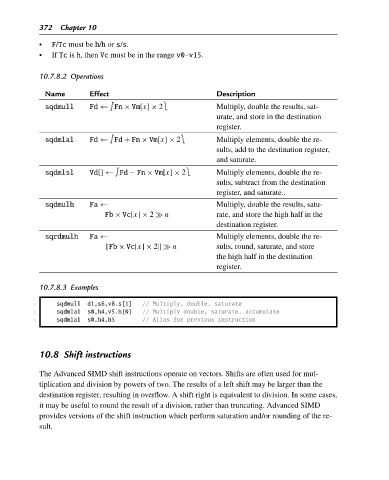
                  10.7.8.2 Operations

                   Name         Effect                             Description
                   sqdmull      Fd ← Fn × Vm[x]× 2                 Multiply, double the results, sat-
                                                                   urate, and store in the destination
                                                                   register.

                   sqdmlal      Fd ← Fd + Fn × Vm[x]× 2            Multiply elements, double the re-
                                                                   sults, add to the destination register,
                                                                   and saturate.
                   sqdmlsl      Vd[] ← Fd − Fn × Vm[x]× 2          Multiply elements, double the re-
                                                                   sults, subtract from the destination
                                                                   register, and saturate..
                   sqdmulh      Fa ←                               Multiply, double the results, satu-
                                    Fb × Vc[x]× 2   n              rate, and store the high half in the
                                                                   destination register.
                   sqrdmulh     Fa ←                               Multiply elements, double the re-
                                     Fb × Vc[x]× 2    n            sults, round, saturate, and store
                                                                   the high half in the destination
                                                                   register.

                  10.7.8.3 Examples


                1     sqdmull  d1,s6,v8.s[1]  // Multiply, double, saturate
                2     sqdmlal  s0,h4,v5.h[0]  // Multiply double, saturate, accumulate
                3     sqdmlal  s0,h4,h5       // Alias for previous instruction


                  10.8 Shift instructions

                  The Advanced SIMD shift instructions operate on vectors. Shifts are often used for mul-
                  tiplication and division by powers of two. The results of a left shift may be larger than the
                  destination register, resulting in overflow. A shift right is equivalent to division. In some cases,
                  it may be useful to round the result of a division, rather than truncating. Advanced SIMD
                  provides versions of the shift instruction which perform saturation and/or rounding of the re-
                  sult.

