


Page 109 - Adsorption, Ion Exchange & Catalysis- 2007, Elsevier - Copy
P. 109
Else_AIEC-INGLE_cH003.qxd  7/13/2006  1:45 PM  Page 105
                  3.4 Slurry Reactors                                     105


                  stoichiometry of the reaction. When applying mass balances in reactors, it is reasonable to
                  base the analysis on the limiting reactant. Consider the catalytic reaction of the form
                                           n A  (g)  m B (g)   pts roduc

                  Suppose that A is in great excess in the gas phase and that its solubility is much lower than
                  that of B. Under this condition, although A is in excess in the gas phase, it could control
                  the reaction rate in the liquid phase where the reaction takes place. Ho considering , er v we
                  the whole reaction system, i.e. the gas and liquid phase, B will run out   first  and is the   real
                  limiting reactant, as defined earlier consider the reaction rate . No w
                                                 r   kC C  n  m
                                                       A  B                         (3.121)

                  The reaction takes place solely in the liquid phase, where B could be in excess. In such
                  cases, it is frequently found that the reaction becomes of zero order with respect to (B), i.e.
                  with respect to the component that is in excess in the reaction space or, in general, depend-
                  ing on the nature of the reaction with respect to the component whose concentration is rel-
                  atively high. In these cases, the reaction rate becomes a function of only the liquid-phase
                  concentration of A.
                    Thus, in three-phase systems, the term “limiting reactant” has two dif ferent meanings:
                  •  Considering the material balances, the limiting reactant is the component that runs out
                     first from the whole reacting system, i.e. both the gas and liquid phase (the reactant B
                     in our case).
                  •  Considering the reaction rate, the limiting reactant is the one that is in shortage in the
                     phase where the reaction takes place (the liquid phase and the reactant A in our case).

                  Gas-phase reaction in continuous and semi-batch oper ations
                  For the common case of continuous operation for both phases, where gas flows under
                  plug-flow condition and liquid under complete mixed-flow condition, and for a reaction of
                  the form (nonreacting liquid phase)
                                            ga
                                            s)
                                          a A( B(ga s)  products
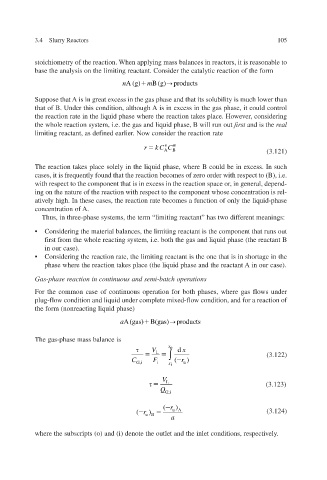
                  The gas-phase mass balance is
                                               	   V    x o  x d
                                                    L    ∫                          (3.122)
                                              C  G,i  F  i  (   r ) u
                                                        x i

                                                      V
                                                   	   L                            (3.123)
                                                      Q
                                                       G,i
                                                       (   r  )
                                               (   r  )     uA                      (3.124)
                                                  uB
                                                         a
                  where the subscripts (o) and (i) denote the outlet and the inlet conditions, respecti v ely .

