


Page 108 - Adsorption, Ion Exchange & Catalysis- 2007, Elsevier - Copy
P. 108
Else_AIEC-INGLE_cH003.qxd  7/13/2006  1:45 PM  Page 104
                    104                             3. Heterogeneous Processes and Reactor  Analysis


                    3.4.3 Slurry bubble column reactors


                    vironmen- Slurry bubble column reactors hae many applications in both industrial and en v
                    xample,
                    tal processes. For e they are used in the Fischer–Tropsch synthesis in industry or ,
                    aste
                    w in water treatment. The most important applications of these reactors are presented
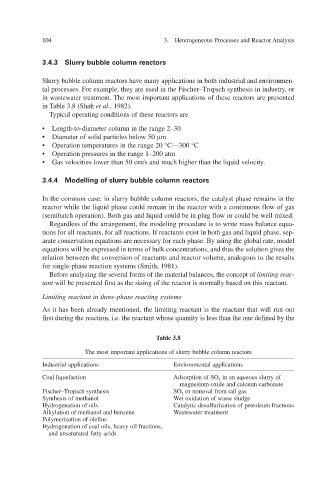
                    in Table 3.8 (Shah   et al.  , 1982).
                      Typical operating conditions of these reactors are
                    •  Length-to-diameter column in the range 2–30
                    •  Diameter of solid particles belo w 50     m
                    •  Operation temperatures in the range 20 °C—300 °C
                    •  Operation pressures in the range 1–200 atm
                    •  Gas velocities lower than 50 cm/s and much higher than the liquid v . elocity

                    3.4.4 Modelling of slurry bubble column reactors

                    In the common case, in slurry bubble column reactors, the catalyst phase remains in the
                    reactor while the liquid phase could remain in the reactor with a continuous flow of gas
                    (semibatch operation). Both gas and liquid could be in plug flow or could be well mix ed.
                      Regardless of the arrangement, the modeling procedure is to write mass balance equa-
                    tions for all reactants, for all reactions. If reactants exist in both gas and liquid phase, sep-
                    arate conservation equations are necessary for each phase. By using the global rate, model
                    equations will be expressed in terms of bulk concentrations, and thus the solution gives the
                    v
                     olume,
                    relation between the conersion of reactants and reactor v analogous to the results
                    for single-phase reaction systems (Smith, 1981).
                      Before analyzing the several forms of the material balances, the concept of   limiting reac-
                    tant  will be presented first as the sizing of the reactor is normally based on this reactant.
                    Limiting reactant in three-phase reacting systems
                    As it has been already mentioned, the limiting reactant is the reactant that will run out
                    first during the reaction, i.e. the reactant whose quantity is less than the one def ined by the

                                                     Table 3.8

                                The most important applications of slurry bubble column reactors
                    Industrial applications  Environmental applications
                    action Coal liquef       Adsorption of SO           in an aqueous slurry of
                                                                      2
                                                           magnesium oxide and calcium carbonate
                    Fischer–Tropsch synthesis  SO            or remoal from tail gas v
                                                            2
                    Synthesis of methanol  Wet oxidation of waste sludge
                    Hydrogenation of oils  Catalytic desulfurization of petroleum fractions
                    Alkylation of methanol and benzene  Wastewater treatment
                    ins Polymerization of olef
                    Hydrogenation of coal oils, heavy oil fractions,
                      and unsaturated fatty acids

