


Page 625 - Advanced_Engineering_Mathematics o'neil
P. 625
16.8 Vibrations in a Circular Membrane II  605


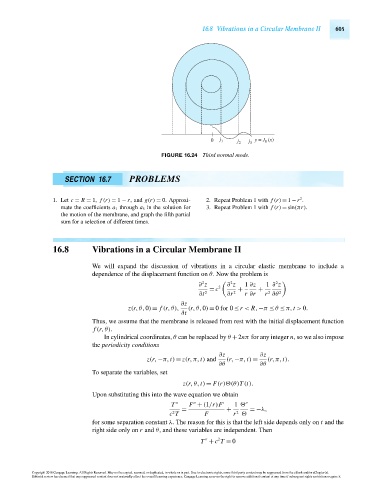
                                                                            0  j 1  j 2  j y = J  (x)
                                                                                            0
                                                                                        3
                                                             FIGURE 16.24 Third normal mode.


                               SECTION 16.7        PROBLEMS


                            1. Let c = R = 1, f (r) = 1 − r,and g(r) = 0. Approxi-  2. Repeat Problem 1 with f (r) = 1 −r .
                                                                                                       2
                              mate the coefficients a 1 through a 5 in the solution for  3. Repeat Problem 1 with f (r) = sin(πr).
                              the motion of the membrane, and graph the fifth partial
                              sum for a selection of different times.


                            16.8        Vibrations in a Circular Membrane II


                                        We will expand the discussion of vibrations in a circular elastic membrane to include a
                                        dependence of the displacement function on θ. Now the problem is
                                                                                                2
                                                                                  2
                                                                         2
                                                                        ∂ z      ∂ z  1 ∂z   1 ∂ z
                                                                           = c 2    +     +
                                                                        ∂t  2    ∂r  2  r ∂r  r ∂θ  2
                                                                                             2
                                                                   ∂z
                                                   z(r,θ,0) = f (r,θ),  (r,θ,0) = 0for 0 ≤r < R,−π ≤ θ ≤ π,t > 0.
                                                                   ∂t
                                        Thus, we assume that the membrane is released from rest with the initial displacement function
                                        f (r,θ).
                                           In cylindrical coordinates, θ can be replaced by θ +2nπ for any integer n, so we also impose
                                        the periodicity conditions
                                                                              ∂z           ∂z
                                                        z(r,−π,t) = z(r,π,t) and  (r,−π,t) =  (r,π,t).
                                                                              ∂θ           ∂θ
                                        To separate the variables, set
                                                                   z(r,θ,t) = F(r) (θ)T (t).
                                        Upon substituting this into the wave equation we obtain
                                                                T      F + (1/r)F     1

                                                                   =             +      =−λ,
                                                               c T        F        r
                                                                                    2
                                                                2
                                        for some separation constant λ. The reason for this is that the left side depends only on t and the
                                        right side only on r and θ, and these variables are independent. Then
                                                                              2
                                                                         T + c T = 0


                      Copyright 2010 Cengage Learning. All Rights Reserved. May not be copied, scanned, or duplicated, in whole or in part. Due to electronic rights, some third party content may be suppressed from the eBook and/or eChapter(s).
                      Editorial review has deemed that any suppressed content does not materially affect the overall learning experience. Cengage Learning reserves the right to remove additional content at any time if subsequent rights restrictions require it.

                                   October 14, 2010  15:23  THM/NEIL   Page-605        27410_16_ch16_p563-610

