


Page 147 - Advanced Gas Turbine Cycles
P. 147
118                       Advanced gas turbine cycles

             Within the steam plant % depends on several factors:
             the boiler and condenser pressures;
           0  the turbine and boiler feed pump efficiencies;
           0  whether or not there is steam reheat;
           0  whether or not there is feed heating and whether the steam is raised in one, two or three
             stages.
             On the other hand  778  depends on some of the following features of  the gas turbine
           plant:
             the gas turbine final exit temperature;
           0  the specific heat capacity of the exhaust gases; and
           0  the allowable final stack temperature.
             The interaction between the gas turbine plant and the steam cycle is complex, and has
           been the subject of much detailed work by many authors [5-81.  A detailed account of
           some of these parametric studies can be found in Ref. [l], and hence they are not discussed
           here. Instead, we first illustrate how the efficiency of  the simplest CCGT plant may be
           calculated. Subsequently, we  summarise the  important features of  the  more complex
           combined cycles.


           7.5.1. A Parametric calculation
             We describe a parametric ‘point’ calculation of the efficiency of a simple CCGT plant,
           firstly with no feed heating. It is supposed that the main parameters of the gas turbine upper
           plant  (pressure  ratio,  maximum  temperature,  and  component  efficiencies)  have  been
           specified and its performance (T&  determined (Fig. 7.3 shows the T, s diagram for the
          two plants and the various state points).
             For the steam plant, the condenser pressure, the turbine and pump efficiencies are also
           specified; there is also a single phase of watedsteam heating, with no reheating. The feed
          pump work term for the relatively low pressure steam cycle is ignored, so that hb = ha. For
          the HRSG two temperature differences are prescribed:
           (a)  the upper temperature difference, AT& = T4  - T,; and
           (b)  the ‘pinch point’ temperature difference, ATk  = T6 - T,.
             With the gas temperature at turbine exit known (T4), the top temperature in the steam
          cycle (T,) is then obtained from (a). It is assumed that this is less than the prescribed
          maximum steam temperature.
             If an evaporation temperature ( p,) is pre-selected as a parametric independent variable,
          then the temperatures and enthalpies at c and e are found; from (b) above the temperature
           T6 is also determined. If there is no heat loss, the heat balance in the HRSG between gas
          states 4 and 6 is

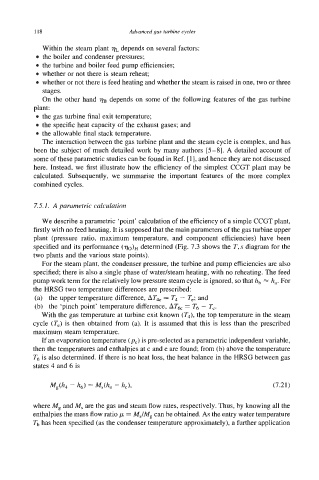
                                                                              (7.21)


          where Mg and M, are the gas and steam flow rates, respectively. Thus, by knowing all the
          enthalpies the mass flow ratio p = MJMg can be obtained. As the entry water temperature
           Tb has been specified (as the condenser temperature approximately), a further application

