


Page 149 - Advances in bioenergy (2016)
P. 149
Box 6.1 Ebullated-Bed Hydroprocessing Reactor

           An innovative reactor configuration* is under development for bio-oil hydroprocessing.
           As an alternative to fixed catalyst bed processing, an ebullated bed has been designed,
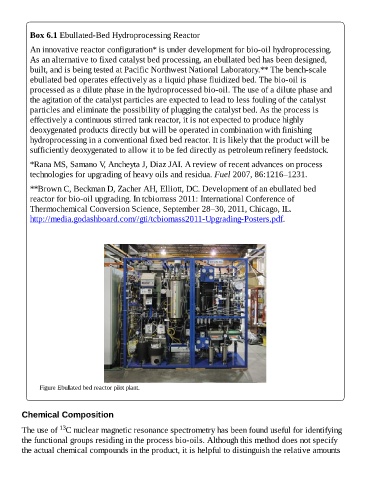
           built, and is being tested at Pacific Northwest National Laboratory.** The bench-scale
           ebullated bed operates effectively as a liquid phase fluidized bed. The bio-oil is
           processed as a dilute phase in the hydroprocessed bio-oil. The use of a dilute phase and
           the agitation of the catalyst particles are expected to lead to less fouling of the catalyst
           particles and eliminate the possibility of plugging the catalyst bed. As the process is
           effectively a continuous stirred tank reactor, it is not expected to produce highly
           deoxygenated products directly but will be operated in combination with finishing
           hydroprocessing in a conventional fixed bed reactor. It is likely that the product will be
           sufficiently deoxygenated to allow it to be fed directly as petroleum refinery feedstock.

           *Rana MS, Samano V, Ancheyta J, Diaz JAI. A review of recent advances on process
           technologies for upgrading of heavy oils and residua. Fuel 2007, 86:1216–1231.

           **Brown C, Beckman D, Zacher AH, Elliott, DC. Development of an ebullated bed
           reactor for bio-oil upgrading. In tcbiomass 2011: International Conference of
           Thermochemical Conversion Science, September 28–30, 2011, Chicago, IL.
           http://media.godashboard.com//gti/tcbiomass2011-Upgrading-Posters.pdf.


              Figure Ebullated bed reactor pilot plant.


        Chemical Composition

                     13
        The use of  C nuclear magnetic resonance spectrometry has been found useful for identifying
        the functional groups residing in the process bio-oils. Although this method does not specify
        the actual chemical compounds in the product, it is helpful to distinguish the relative amounts

