


Page 147 - Advances in bioenergy (2016)
P. 147
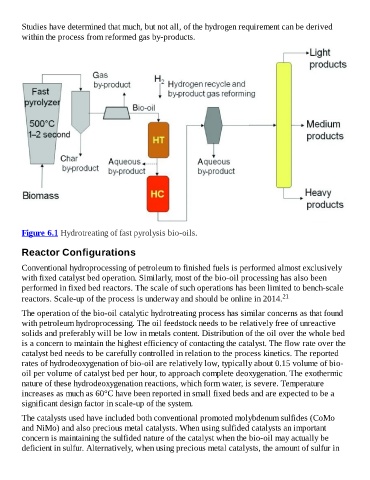
Studies have determined that much, but not all, of the hydrogen requirement can be derived
        within the process from reformed gas by-products.


        Figure 6.1 Hydrotreating of fast pyrolysis bio-oils.


        Reactor Configurations

        Conventional hydroprocessing of petroleum to finished fuels is performed almost exclusively

        with fixed catalyst bed operation. Similarly, most of the bio-oil processing has also been
        performed in fixed bed reactors. The scale of such operations has been limited to bench-scale
        reactors. Scale-up of the process is underway and should be online in 2014.           21

        The operation of the bio-oil catalytic hydrotreating process has similar concerns as that found
        with petroleum hydroprocessing. The oil feedstock needs to be relatively free of unreactive
        solids and preferably will be low in metals content. Distribution of the oil over the whole bed
        is a concern to maintain the highest efficiency of contacting the catalyst. The flow rate over the
        catalyst bed needs to be carefully controlled in relation to the process kinetics. The reported
        rates of hydrodeoxygenation of bio-oil are relatively low, typically about 0.15 volume of bio-
        oil per volume of catalyst bed per hour, to approach complete deoxygenation. The exothermic
        nature of these hydrodeoxygenation reactions, which form water, is severe. Temperature
        increases as much as 60°C have been reported in small fixed beds and are expected to be a
        significant design factor in scale-up of the system.


        The catalysts used have included both conventional promoted molybdenum sulfides (CoMo
        and NiMo) and also precious metal catalysts. When using sulfided catalysts an important
        concern is maintaining the sulfided nature of the catalyst when the bio-oil may actually be
        deficient in sulfur. Alternatively, when using precious metal catalysts, the amount of sulfur in

