


Page 142 - Advances in bioenergy (2016)
P. 142
the laboratory into scaled-up process demonstration systems.


        BIOMASS FAST PYROLYSIS


        Pyrolysis is the thermal decomposition and devolatilization by heating in the absence of
        oxygen. Biomass pyrolysis is an ancient technology, as old as fire itself. The terra preta soils
        of the Amazon basin have been attributed to charcoal production by pyrolysis and burial of the
                                                3
        charcoal by prehistoric inhabitants.  Wood tar was produced from pyrolysis by the ancient
                    4
        Egyptians.  The biostructures in biomass begin to thermally decompose at temperatures as low
        as 200°C. By processing biomass in an oxygen-deficient atmosphere, a range of products is
        derived as a function of temperature and amount of oxygen. A second operating axis to
        consider is the time at temperature, which at extended times leads to the formation of
        secondary products from the primary pyrolysis products. In the case of biomass pyrolysis,

        low-temperature processing releases primary decomposition products mostly water vapor and
        carbon dioxide with a residual solid condensation product. With increasing temperature, the
        decomposition of the biopolymers increases and volatile products tend toward a higher
        molecular weight, which, if cooled and condensed quickly, can be recovered as liquid with
        minimal amounts of gas or solid products. At higher temperature, the decomposition products
        continue to be broken down to lower molecular weight gaseous products. The old, simple
        technology of pyrolysis as practiced at relatively lower temperatures and long heating and
        cooling times, maximizes the solid product yield. More recent interest has moved the process
        research to focus on liquid organic products, and, as a result, fast pyrolysis has been
        developed with moderately higher temperatures but very short residence times.

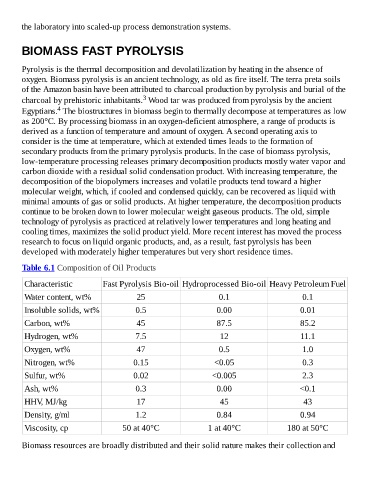
        Table 6.1 Composition of Oil Products


         Characteristic            Fast Pyrolysis Bio-oil Hydroprocessed Bio-oil Heavy Petroleum Fuel

         Water content, wt%                   25                         0.1                         0.1
         Insoluble solids, wt%                0.5                        0.00                       0.01

         Carbon, wt%                          45                         87.5                       85.2

         Hydrogen, wt%                        7.5                         12                        11.1
         Oxygen, wt%                          47                         0.5                         1.0

         Nitrogen, wt%                       0.15                       <0.05                        0.3

         Sulfur, wt%                         0.02                      <0.005                        2.3

         Ash, wt%                             0.3                        0.00                       <0.1
         HHV, MJ/kg                           17                          45                         43

         Density, g/ml                        1.2                        0.84                       0.94

         Viscosity, cp                   50 at 40°C                   1 at 40°C                 180 at 50°C

        Biomass resources are broadly distributed and their solid nature makes their collection and

