


Page 237 - Advances in Textile Biotechnology
P. 237
218    Advances in textile biotechnology


              the mild conditions assured by the specificity and selectivity of enzymes.

              With reference to silk fibres, the accessibility and reactivity of surface-
              available tyrosyl residues still remain to be proved. Overcoming of the
              current limitations will allow development of innovative techniques for
              surface functionalisation of textile fi bres.


              9.6    Other enzymes for protein fi bre functionalisation
              In addition to transglutaminases and tyrosinases, other enzymes have
              attracted some interest for their ability to interact with protein fi bre sub-
              strates. Such is the case for laccases and peroxidases, both belonging to the
              group of oxidoreductases. Laccases (p-diphenol : dioxygen oxidoreductase,
              EC 1.10.3.2) are Cu-containing enzymes, having four Cu atoms in their
              reactive site, which are able to oxidise their substrates by removing one
              electron and using oxygen as terminal electron acceptor (Riva, 2006;
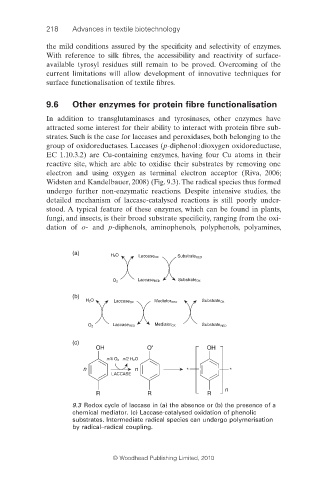
              Widsten and Kandelbauer, 2008) (Fig. 9.3). The radical species thus formed
              undergo further non-enzymatic reactions. Despite intensive studies, the
              detailed mechanism of laccase-catalysed reactions is still poorly under-
              stood. A typical feature of these enzymes, which can be found in plants,
              fungi, and insects, is their broad substrate specificity, ranging from the oxi-

              dation of  o- and  p-diphenols, aminophenols, polyphenols, polyamines,


                     (a)        H 2 O  Laccase OX  Substrate RED


                                O 2    Laccase RED  Substrate OX

                     (b)
                         H 2 O
                                Laccase OX  Mediator RED  Substrate OX

                         O 2    Laccase RED  Mediator OX  Substrate RED

                     (c)
                            OH            O •             OH
                               n/4 O 2 n/2 H 2 O
                        n             n              *          *
                                LACCASE

                                                               n
                            R             R               R
                     9.3  Redox cycle of laccase in (a) the absence or (b) the presence of a
                     chemical mediator. (c) Laccase-catalysed oxidation of phenolic
                     substrates. Intermediate radical species can undergo polymerisation
                     by radical–radical coupling.


                                © Woodhead Publishing Limited, 2010

