


Page 162 - Advances in bioenergy the sustainability challenge
P. 162
mainly through noncatalytic steam cracking of fossil fuels (naphtha).        19

        The MtO process, however, uses zeolite-based catalysts that efficiently convert methanol into
        propylene and ethylene.


        Dimethyl Ether

        Dimethyl ether (DME) or (CH3OCH3) is generally produced by dehydration of methanol. In
        recent R&D projects, the methanol production and dehydration processes are combined in one
        reactor, such that DME is produced directly from synthesis gas slightly more efficient than

        methanol. In addition, the direct synthesis of DME allows H :CO ratios of about 1, which is an
                                                                            2
        advantage for oxygen blown gasifiers.

        Like methanol, DME has promising features as fuel candidate with both the otto and the diesel
        engine (www.biodme.eu). With adaptations to engine and fuel system, DME can be used in
        diesel engines, leading to higher fuel efficiency and lower emissions. In otto engines, DME can
        be used with liquefied petroleum gas (LPG). Since DME is as easily reformed as methanol, it
                                                              20
        has a big potential as fuel for fuel cell vehicles.  DME has similar physical properties as LPG
        and can be handled as a liquid, using the same infrastructure as LPG.         21


        Mixed Alcohols

        The catalytic conversion of synthesis gas to mixed alcohols is nowadays of great importance
        because mixed alcohols are valuable additives to gasoline to increase the octane number and
        reduce the environmental pollution. Furthermore, a great benefit of the mixed alcohol synthesis
        is the high resistance of the catalysts against sulfur poisoning and the fact that the gas cleaning
        facilities can be simpler as in other syntheses. Mixed alcohols can also be converted to high-
        quality fuels via dehydration and oligomerization.

        Normally, the alkali-doped oxides (zinc and chromium oxides) and alkali-doped sulfides
        (molybdenum sulfides) are used as catalysts for mixed alcohols synthesis (MAS).

        Depending on process conditions and catalysts, the main primary products are generally
        methanol and water. Ethanol, propanol, butanol, etc. are gradually including methanol synthesis
                                                       22
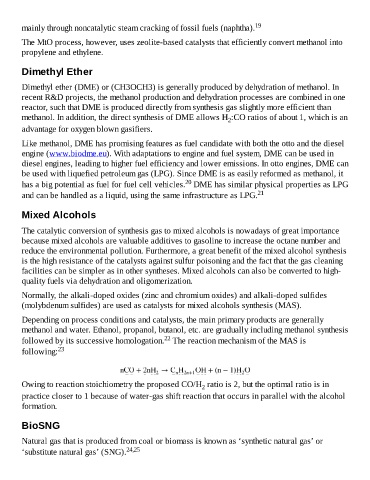
        followed by its successive homologation.  The reaction mechanism of the MAS is
        following:  23


        Owing to reaction stoichiometry the proposed CO/H  ratio is 2, but the optimal ratio is in
                                                                    2
        practice closer to 1 because of water-gas shift reaction that occurs in parallel with the alcohol
        formation.


        BioSNG

        Natural gas that is produced from coal or biomass is known as ‘synthetic natural gas’ or
        ‘substitute natural gas’ (SNG).    24,25

