


Page 233 - Aerodynamics for Engineering Students
P. 233
21 6  Aerodynamics for Engineering Students


                    Fig. 5.6


                    5.2.2  The Biot-Savart  law
                    The original application of this law was in electromagnetism, where it relates the
                    intensity of the magnetic field in the vicinity  of a  conductor  carrying an electric
                    current  to the magnitude of  the  current.  In the present application velocity and
                    vortex strength (circulation) are analogous to the magnetic field strength and electric
                    current respectively, and a vortex filament replaces the electrical conductor. Thus the
                    Biot-Savart  law can  also be  interpreted  as the  relationship between  the velocity
                    induced by a vortex tube and the strength (circulation) of the vortex tube. Only the
                    fluid motion aspects will be  further pursued here, except to remark that the term
                    induced velocity, used to describe the velocity generated at a distance by the vortex
                    tube, was borrowed from electromagnetism.
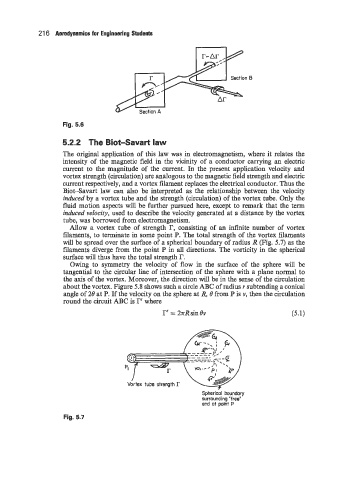
                      Allow  a  vortex tube  of  strength I?,  consisting of  an infinite number of  vortex
                    filaments, to terminate in some point P. The total strength of the vortex filaments
                    will be spread over the surface of a spherical boundary of radius R (Fig. 5.7) as the
                    filaments diverge from the point P in all directions. The vorticity in the spherical
                    surface will thus have the total strength I?.
                      Owing to  symmetry the  velocity  of  flow  in  the  surface of  the  sphere will  be
                    tangential to the circular line of intersection of the sphere with a plane normal to
                    the axis of the vortex. Moreover, the direction will be in the sense of the circulation
                    about the vortex. Figure 5.8 shows such a circle ABC of radius I subtending a conical
                    angle of 28 at P. If the velocity on the sphere at R, 8 from P is v, then the circulation
                    round the circuit ABC is I?’  where
                                                 I?’ = 21rR sin 8v                      (5.1)


                                                             Spherical boundary
                                                             surrounding ‘free’
                                                             end at point P

                    Fig. 5.7

