


Page 319 - Aerodynamics for Engineering Students
P. 319
Compressible flow  301

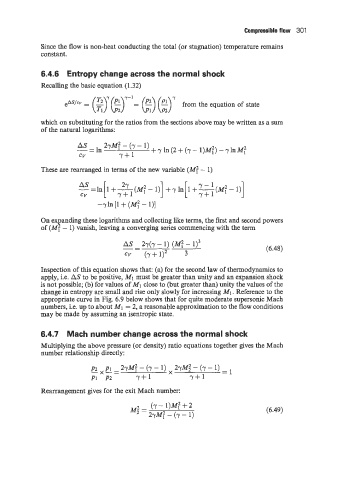
             Since the flow is non-heat conducting the total (or stagnation) temperature remains
             constant.


             6.4.6  Entropy change across the normal shock
                                           e)
             Recalling the basic equation (1.32)
                                                (E)'

                          = (~~~~-'= equation of  state
                                                            the
                                                       from
             which on substituting for the ratios from the sections above may be written as a sum
             of the natural logarithms:


             These are rearranged in terms of the new variable (M: - 1)


             On ex  anding these logarithms and collecting like terms, the first and second powers
             of (M, !i? - 1) vanish, leaving a converging series commencing with the term


                                                                                (6.48)


             Inspection of this equation shows that: (a) for the second law of thermodynamics to
             apply, i.e. AS to be positive, M1 must be greater than unity and an expansion shock
             is not possible; (b) for values of M1 close to (but greater than) unity the values of the
             change in entropy are small and rise only slowly for increasing MI. Reference to the
             appropriate curve in Fig. 6.9 below shows that for quite moderate supersonic Mach
             numbers, i.e. up to about M1  = 2, a reasonable approximation to the flow conditions
             may be made by assuming an isentropic state.


             6.4.7  Mach number change across the normal shock
             Multiplying the above pressure (or density) ratio equations together gives the Mach
             number relationship directly:


                            p2 xp' = 2YM;  - (7- 1)  2YM;  - (7 - 1)  =1
                            P1  P2       Y+l             Y+l

             Rearrangement gives for the exit Mach number:

                                                                                (6.49)

