


Page 315 - Aerodynamics for Engineering Students
P. 315
Compressible flow  297

               If  a disturbance of large amplitude, e.g. a rapid pressure rise, is set up there are
              almost immediate physical limitations to its continuous propagation. The accelera-
              tions of individual particles required for continuous propagation cannot be sustained
              and a pressure front or discontinuity is built up. This pressure front is known as a
              shock wave which travels through the gas at a speed, always in excess of the acoustic
              speed, and together with the pressure jump, the density, temperature and entropy of
              the gas increases suddenly while the normal velocity drops.
                Useful  and  quite  adequate expressions for the change of  these flow properties
              across  the  shock  can  be  obtained  by  assuming that  the  shock  front  is  of  zero
              thickness. In fact the shock wave is of finite thickness being a few molecular mean
              free path lengths in magnitude, the number depending on the initial gas conditions
              and the intensity of the shock.

              6.4.1  One-dimensional properties of normal shock waves
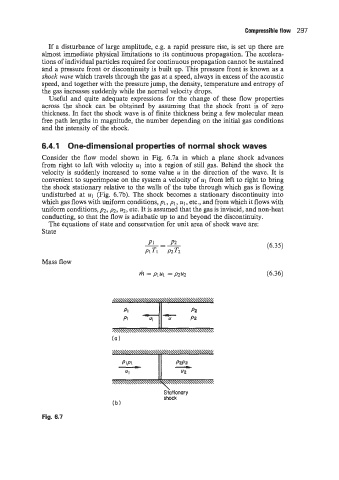
              Consider  the  flow  model  shown  in  Fig.  6.7a  in  which  a  plane  shock  advances
              from right to left with velocity u1 into a region of  still gas. Behind the shock the
             velocity is  suddenly increased to  some value u in the direction of  the wave. It is
              convenient to superimpose on the system a velocity of u1  from left to right to bring
              the shock stationary relative to the walls of the tube through which gas is flowing
             undisturbed  at u1 (Fig. 6.7b). The shock becomes a  stationary  discontinuity into
              which gas flows with uniform conditions,  p1, p1, u1, etc., and from which it flows with
             uniform conditions,  p2, p2, u2, etc. It is assumed that the gas is inviscid, and non-heat
              conducting, so that the flow is adiabatic up to and beyond the discontinuity.
               The equations of state and conservation for unit area of shock wave are:
              State

                                                                                (6.35)

              Mass flow


                                                  Siationary
                                                  shock
                                   (b)
              Fig. 6.7

