


Page 313 - Aerodynamics for Engineering Students
P. 313
Compressible flow  295
                     -
                      u)


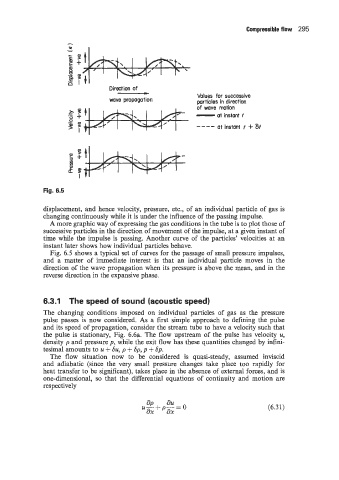
                                  Direction  of
                                    T                       Values  for  successive
                                  wave  propagation         particles in direction
                                                            of wave  motion
                                                           - instant t
                                                                  at
                                                            ----  at instant  t + 6t


              Fig. 6.5

              displacement, and hence velocity, pressure, etc., of  an individual particle of gas is
              changing continuously while it is under the influence of the passing impulse.
                A more graphic way of expressing the gas conditions in the tube is to plot those of
              successive particles in the direction of movement of the impulse, at a given instant of
              time while the impulse is  passing. Another  curve of  the particles’ velocities at an
              instant later shows how individual particles behave.
                Fig. 6.5 shows a typical set of curves for the passage of small pressure impulses,
              and  a  matter  of  immediate  interest  is  that  an  individual particle  moves  in  the
              direction of the wave propagation when its pressure is above the mean, and in the
              reverse direction in the expansive phase.


              6.3.1  The speed of sound (acoustic speed)
              The  changing conditions imposed  on  individual particles of  gas  as  the  pressure
              pulse passes is now  considered. As  a  first simple approach  to defining the pulse
              and its speed of propagation, consider the stream tube to have a velocity such that
              the pulse is  stationary,  Fig.  6.6a.  The flow upstream of  the pulse has velocity u,
              density p and pressure p, while the exit flow has these quantities changed by infini-
              tesimal amounts to u + Su, p + Spy p + Sp.
                The  flow  situation  now  to  be  considered  is  quasi-steady,  assumed  inviscid
              and  adiabatic  (since the  very  small pressure changes take  place  too  rapidly  for
              heat transfer to be significant), takes place in the absence of  external forces, and is
              one-dimensional, so that  the  differential equations  of  continuity and motion  are
              respectively

                                             ap    au
                                           u-+p-=o                               (6.31)
                                             ax    ax

