


Page 311 - Aerodynamics for Engineering Students
P. 311
Compressible flow  293

             and the local speed of sound over the panel, al, is
                                     a1  = 20.05(228)'/2 = 305ms-'

             Therefore, flow speed over the panel
                                      q = 305 x 1.103 = 338ms-'

             which agrees with the answer obtained by method (a).
               An  interesting  feature  of  this  example is  that,  although  the  flight  speed  is  subsonic
             (M = 0.85), the flow over the panel is supersonic. This fact was used in the 'wing-flow'  method
             of transonic research. The method dates from about 1940, when transonic wind-tunnels were
             unsatisfactory. A small model was mounted on the upper surface of the wing of an aeroplane,
             which then dived at near maximum speed. As a result the model experienced a flow that was
             supersonic locally. The method, though not very satisfactory, was an improvement on other
             methods available at that time.

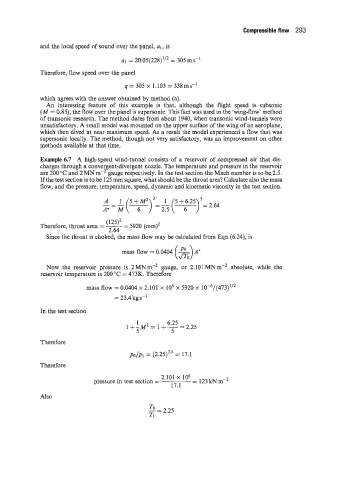
             Example 6.7  A  high-speed  wind-tunnel consists of  a reservoir of  compressed  air that  dis-
             charges through a convergent-divergent nozzle. The temperature and pressure in the reservoir
             are 200 "C and 2 MNrnp2 gauge respectively. In the test section the Mach number is to be 2.5.
             If the test section is to be 125 mm square, what should be the throat area? Calculate also the mass
             flow, and the pressure, temperature, speed, dynamic and kinematic viscosity in the test section.

                                A    1  5+M2      1  5+6.25
                                -=--           =--
                                A*  M(  6  )  2.5(      6   )=2.64
                                 ( 12q2
             Therefore, throat area = - 5920 (mm)*
                                      =
                                 2.64
               Since the throat is choked, the mass flow may be calculated from Eqn (6.24), is
                                                     (3
                                     massflow=0.0404  - A*

               Now  the  reservoir  pressure  is  2MNm-2  gauge,  or  2.101 MNm-2  absolute, while  the
             reservoir temperature is 200 "C = 473K. Therefore

                           mass flow = 0.0404 x 2.101 x  lo6 x 5920 x 10-6/(473)''2
                                   = 23.4 kg s-l

             In the test section
                                          1        6 25
                                       1 + -M2 = 1 + - 2.25
                                                      =
                                          5         5
             Therefore
                                        po/pl  = (2.25)3.5 = 17.1
             Therefore
                                                 2.101 x  106
                             pressure in test section =   = 123 kNm-2
                                                    17.1
             Also
                                             -- - 2.25
                                             To
                                             TI

