


Page 306 - Aerodynamics for Engineering Students
P. 306
288  Aerodynamics for Engineering Students

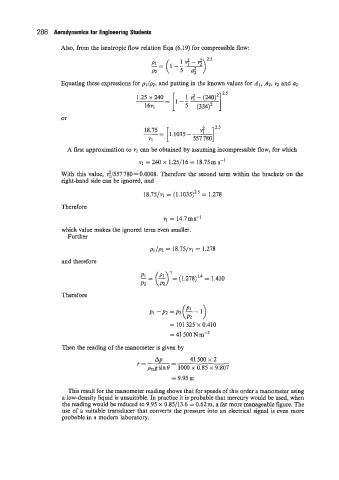
                   Also, from the isentropic flow relation Eqn (6.19) for compressible flow:


                   Equating these expressions for PI/&, and putting in the known values for AI, A2, v2  and a2
                                            16vl  [     5  (334)2  1
                                          1.25 x 240    1 v:  - (240)2 2'5
                                                  =  1--
                   or


                                             v1
                     A first approximation to v1  can be obtained by assuming incompressible flow, for which
                                          v1  = 240 x  1.25/16 = 18.75m s-l

                   With this value, v:/557  780 = 0.0008. Therefore the second term within the brackets on the
                   right-hand side can be ignored, and
                                            18.75/v1 = (1.1035)2'5 = 1.278

                   Therefore
                                                  v1  = 14.7ms-'
                   which value makes the ignored term even smaller.
                     Further
                                              p1/p2  = 18.75/~1 = 1.278

                   and therefore
                                                   7
                                           E = (2) = (1.278)'.4 = 1.410

                   Therefore
                                                       t)
                                             PI  -p2  =pz  -- 1

                                                   = 101 325 x 0.410
                                                   = 41 500Nm-2

                   Then the reading of the manometer is given by
                                               AP        41 500 x 2
                                          r=--
                                             hgsint9 - 1000 x 0.85 x 9.807
                                                    = 9.95 m

                     This result for the manometer reading shows that for speeds of this order a manometer using
                   a low-density liquid is unsuitable. In practice it is probable that mercury would be used, when
                   the reading would be reduced to 9.95 x 0.85113.6 = 0.62m, a far more manageable figure. The
                   use of a suitable transducer that converts the pressure into an electrical signal is even more
                   probable in a modem laboratory.

