


Page 304 - Aerodynamics for Engineering Students
P. 304
286  Aerodynamics for Engineering Students

                                          I


                                  PIP0  0.6                       ,---D
                                       0.4
                                       0.2


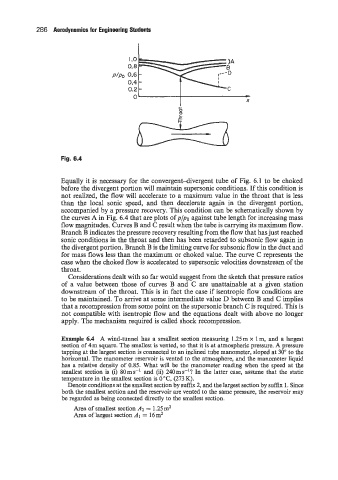
                   Fig. 6.4


                   Equally it is necessary for the convergent-divergent tube of  Fig. 6.1 to be choked
                   before the divergent portion will maintain supersonic conditions. If this condition is
                   not realized, the flow will accelerate to a maximum value in the throat that is less
                   than  the  local  sonic speed,  and  then  decelerate  again  in  the  divergent portion,
                   accompanied by a pressure recovery. This condition can be schematically shown by
                   the curves A in Fig. 6.4 that are plots of p/po against tube length for increasing mass
                   flow magnitudes. Curves B and C result when the tube is carrying its maximum flow.
                   Branch B indicates the pressure recovery resulting from the flow that has just reached
                   sonic conditions in the throat and then has been retarded to subsonic flow again in
                   the divergent portion. Branch B is the limiting curve for subsonic flow in the duct and
                   for mass flows less than the maximum or choked value. The curve C represents the
                   case when the choked flow is accelerated to supersonic velocities downstream of the
                   throat.
                     Considerations dealt with so far would suggest from the sketch that pressure ratios
                   of  a value  between those  of  curves B and  C  are unattainable  at a  given station
                   downstream of  the throat. This is in fact the case if isentropic flow conditions are
                   to be maintained. To arrive at some intermediate value D between B and C implies
                   that a recompression from some point on the supersonic branch C is required. This is
                   not compatible with isentropic flow and the equations dealt with above no longer
                   apply. The mechanism required is called shock recompression.

                   Example  6.4  A wind-tunnel has a  smallest section measuring  1.25m x  1 m,  and a largest
                   section of 4m square. The smallest is vented, so that it is at atmospheric pressure. A pressure
                   tapping at the largest section is connected to an inclined tube manometer, sloped at 30" to the
                   horizontal. The manometer reservoir is vented to the atmosphere, and the manometer liquid
                   has a relative density of  0.85.  What will  be  the manometer reading when  the speed at the
                   smallest section is (i)  80ms-'  and (ii)  240ms-'?  In the latter case,  assume that  the static
                   temperature in the smallest section is 0 "C, (273 K).
                     Denote conditions at the smallest section by suffix 2, and the largest section by sufix 1. Since
                   both the smallest section and the reservoir are vented to the same pressure, the reservoir may
                   be regarded as being connected directly to the smallest section.
                       Area of smallest section A2  = 1.25mZ
                       Area of largest section A1  = 16 mz

