


Page 303 - Aerodynamics for Engineering Students
P. 303
Compressible flow  285


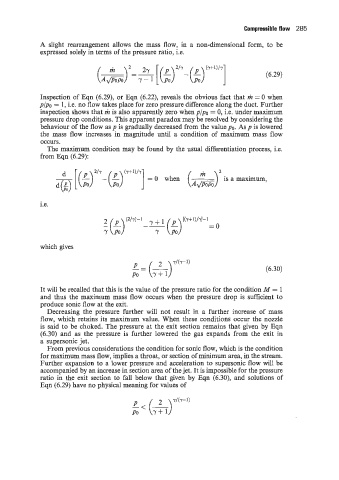
             A  slight rearrangement allows the  mass  flow, in  a  non-dimensional form, to  be
             expressed solely in terms of the pressure ratio, i.e.


                                                                                (6.29)


             Inspection of Eqn (6.29), or Eqn (6.22), reveals the obvious fact that riz = 0 when
             p/po = 1, i.e. no flow takes place for zero pressure difference along the duct. Further
             inspection shows that riz is also apparently zero when p/po = 0, i.e. under maximum
             pressure drop conditions. This apparent paradox may be resolved by considering the
             behaviour of the flow as p is gradually decreased from the value PO. As p is lowered
             the  mass  flow increases in  magnitude until  a  condition  of  maximum mass  flow
             occurs.
               The maximum condition may be found by the usual differentiation process, Le.
             from Eqn (6.29):
                  6                   (Y+l)lY  ] = 0  when   ~    2  is a maximum,
                       [
                  dE
                        (;)2’7-(;)

             i.e.


             which gives


                                                                                (6.30)


             It will be recalled that this is the value of the pressure ratio for the condition M  = 1
             and  thus the maximum mass flow occurs when  the pressure drop is  sufficient to
             produce sonic flow at the exit.
               Decreasing the  pressure  further  will  not  result  in  a  further  increase of  mass
             flow, which retains its maximum value. When these conditions occur the nozzle
             is said to be choked. The pressure at the exit section remains that given by  Eqn
             (6.30)  and  as the  pressure is  further  lowered  the  gas  expands from  the  exit  in
             a  supersonic jet.
               From previous considerations the condition for sonic flow, which is the condition
             for maximum mass flow, implies a throat, or section of minimum area, in the stream.
             Further expansion to a lower pressure and acceleration to supersonic flow will be
             accompanied by an increase in section area of the jet. It is impossible for the pressure
             ratio in the  exit  section to  fall below that  given by  Eqn  (6.30), and  solutions of
             Eqn (6.29) have no physical meaning for values of

