


Page 357 - Amphibionics : Build Your Own Biologically Inspired Robot
P. 357
Amphibionics 07  3/24/03  9:13 AM  Page 336
                                          stopped and the next sonar distance reading is taken. This indi-
                                          cates that the motor has moved the wheel by 1/12 of a complete
                                          rotation.    Amphibionics
                                          When all of the sonar distance measurements have been taken, a
                                          sorting algorithm determines which position contains the distance
                                          measurement  with  the  highest  value.  The  robot  is  then  rotated
                                          back to the position with the greatest amount of free space, and
                                          then moves forward to map out the surrounding area. If an obsta-
                                          cle is encountered while moving forward, the robot backs up and
                                          makes another map to determine the best route to take. Compile
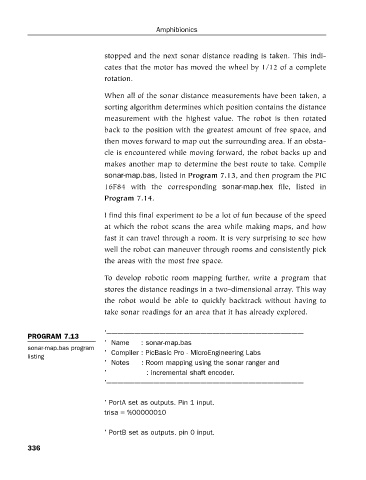
                                          sonar-map.bas, listed in Program 7.13, and then program the PIC
                                          16F84  with  the  corresponding  sonar-map.hex file,  listed  in
                                          Program 7.14.
                                          I find this final experiment to be a lot of fun because of the speed
                                          at which the robot scans the area while making maps, and how
                                          fast it can travel through a room. It is very surprising to see how
                                          well the robot can maneuver through rooms and consistently pick
                                          the areas with the most free space.
                                          To  develop  robotic  room  mapping  further,  write  a  program  that
                                          stores the distance readings in a two-dimensional array. This way
                                          the robot would be able to quickly backtrack without having to
                                          take sonar readings for an area that it has already explored.

                                          '------------------------------------------------------------------------------------------------------------------------------
                      PROGRAM 7.13
                                          '  Name     : sonar-map.bas
                      sonar-map.bas program
                                          '  Compiler : PicBasic Pro - MicroEngineering Labs
                      listing
                                          '  Notes     : Room mapping using the sonar ranger and
                                          '                 : incremental shaft encoder.
                                          '------------------------------------------------------------------------------------------------------------------------------

                                          ' PortA set as outputs. Pin 1 input.
                                          trisa = %00000010

                                          ' PortB set as outputs. pin 0 input.

                      336

