


Page 116 - Analysis and Design of Energy Geostructures
P. 116
88    Analysis and Design of Energy Geostructures


                   The rate equation governing convection is Newton’s law of cooling. According to
                                                                    , reads
                this law, the heat flux density generated by convection, _q
                                                                 conv
                                                 5 h c T s 2 T N Þ                     ð3:5Þ
                                                     ð
                                             _ q
                                              conv
                where h c is the convection heat transfer coefficient (also termed boundary or film con-
                ductance), T s is the surface temperature and T N is the fluid temperature. In this case it
                is assumed that the convection heat flux is positive if heat is transferred from the sur-
                face (T s . T N ) and negative if heat is transferred to the surface (T s , T N ). However,
                                                     5 h c T N 2 T s Þ.
                                                         ð
                the heat flux may also be expressed as _q
                                                  conv
                   Eq. (3.5) is typically employed in the context of the analysis of internal and exter-
                nal flows. In the context of the analysis of seepage flows, Newton’s law of cooling is
                expressed as
                                          q_  5 ρ c p;f v rf ;i T s 2 T N Þ            ð3:6Þ
                                                        ð
                                           conv;i  f
                where c p;f and ρ are the specific heat and density of the fluid, respectively, and v rf ;i is
                              f
                the average relative velocity vector of the fluid with respect to the solid skeleton.
                Eq. (3.6) is employed in the analysis of groundwater seepage to characterise the heat
                transported by water motion with reference to the specific heat and density of the
                water, c pw and ρ , respectively, and the average relative velocity of water with respect
                              w
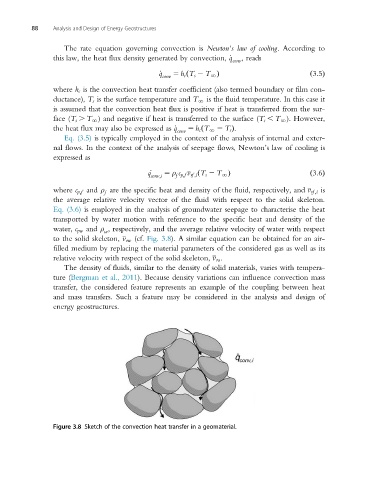
                to the solid skeleton, v rw (cf. Fig. 3.8). A similar equation can be obtained for an air-
                filled medium by replacing the material parameters of the considered gas as well as its
                relative velocity with respect of the solid skeleton, v ra .
                   The density of fluids, similar to the density of solid materials, varies with tempera-
                ture (Bergman et al., 2011). Because density variations can influence convection mass
                transfer, the considered feature represents an example of the coupling between heat
                and mass transfers. Such a feature may be considered in the analysis and design of
                energy geostructures.


                Figure 3.8 Sketch of the convection heat transfer in a geomaterial.

