


Page 118 - Analysis and Design of Energy Geostructures
P. 118
90    Analysis and Design of Energy Geostructures


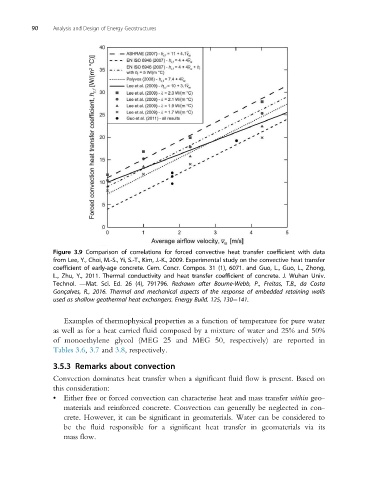
                Figure 3.9 Comparison of correlations for forced convective heat transfer coefficient with data
                from Lee, Y., Choi, M.-S., Yi, S.-T., Kim, J.-K., 2009. Experimental study on the convective heat transfer
                coefficient of early-age concrete. Cem. Concr. Compos. 31 (1), 6071. and Guo, L., Guo, L., Zhong,
                L., Zhu, Y., 2011. Thermal conductivity and heat transfer coefficient of concrete. J. Wuhan Univ.
                Technol. —Mat. Sci. Ed. 26 (4), 791796. Redrawn after Bourne-Webb, P., Freitas, T.B., da Costa
                Gonçalves, R., 2016. Thermal and mechanical aspects of the response of embedded retaining walls
                used as shallow geothermal heat exchangers. Energy Build. 125, 130 141.


                   Examples of thermophysical properties as a function of temperature for pure water
                as well as for a heat carried fluid composed by a mixture of water and 25% and 50%
                of monoethylene glycol (MEG 25 and MEG 50, respectively) are reported in
                Tables 3.6, 3.7 and 3.8, respectively.

                3.5.3 Remarks about convection
                Convection dominates heat transfer when a significant fluid flow is present. Based on
                this consideration:
                •  Either free or forced convection can characterise heat and mass transfer within geo-
                   materials and reinforced concrete. Convection can generally be neglected in con-
                   crete. However, it can be significant in geomaterials. Water can be considered to
                   be the fluid responsible for a significant heat transfer in geomaterials via its
                   mass flow.

