


Page 149 - Anatomy of a Robot
P. 149
04_200256_CH04/Bergren  4/10/03  11:59 AM  Page 134
                             134 CHAPTER FOUR
                             of amplitude. Be aware that such tables have a weight limit. The robot must be light
                             enough that the table can accommodate it and still be able to vibrate. The vibrations are
                             effectively three-dimensional with each dimension’s vibration approximated by a sine
                             function. The amplitude of the vibration is as follows:
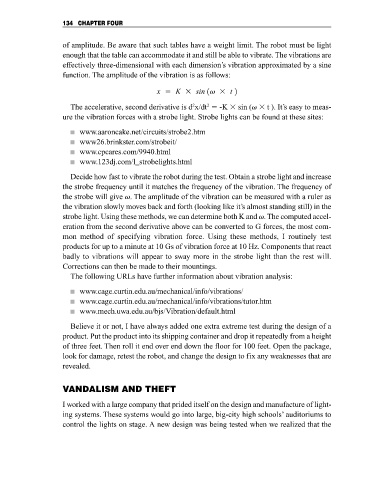
                                                      x     K     sin 1v     t 2
                                                                2
                                                                    2
                               The accelerative, second derivative is d x/dt   -K   sin (v   t ). It’s easy to meas-
                             ure the vibration forces with a strobe light. Strobe lights can be found at these sites:
                                 www.aaroncake.net/circuits/strobe2.htm
                                 www26.brinkster.com/strobeit/
                                 www.cpcares.com/9940.html
                                 www.123dj.com/l_strobelights.html
                               Decide how fast to vibrate the robot during the test. Obtain a strobe light and increase
                             the strobe frequency until it matches the frequency of the vibration. The frequency of
                             the strobe will give v. The amplitude of the vibration can be measured with a ruler as
                             the vibration slowly moves back and forth (looking like it’s almost standing still) in the
                             strobe light. Using these methods, we can determine both K and v. The computed accel-
                             eration from the second derivative above can be converted to G forces, the most com-
                             mon  method  of  specifying  vibration  force.  Using  these  methods,  I  routinely  test
                             products for up to a minute at 10 Gs of vibration force at 10 Hz. Components that react
                             badly to vibrations will appear to sway more in the strobe light than the rest will.
                             Corrections can then be made to their mountings.
                               The following URLs have further information about vibration analysis:

                                 www.cage.curtin.edu.au/mechanical/info/vibrations/
                                 www.cage.curtin.edu.au/mechanical/info/vibrations/tutor.htm
                                 www.mech.uwa.edu.au/bjs/Vibration/default.html

                               Believe it or not, I have always added one extra extreme test during the design of a
                             product. Put the product into its shipping container and drop it repeatedly from a height
                             of three feet. Then roll it end over end down the floor for 100 feet. Open the package,
                             look for damage, retest the robot, and change the design to fix any weaknesses that are
                             revealed.


                             VANDALISM AND THEFT

                             I worked with a large company that prided itself on the design and manufacture of light-
                             ing systems. These systems would go into large, big-city high schools’ auditoriums to
                             control the lights on stage. A new design was being tested when we realized that the

