


Page 212 - Anatomy of a Robot
P. 212
08_200256_CH08/Bergren  4/10/03  4:39 PM  Page 197
                                                                     DIGITAL SIGNAL PROCESSING (DSP) 197
                              Here are some further descriptions of the Sampling Theorem:
                                http://ccrma-www.stanford.edu/ jos/r320/Shannon_s_Sampling_
                                 Theorem.html
                                http://ptolemy.eecs.berkeley.edu/eecs20/week13/nyquistShannon.html
                                www.hsdal.ufl.edu/Projects/IntroDSP/Notes/Sampling%20Theorem
                                 %20Brief.doc
                              If you want to have some fun with language, take a look at the www.nightgarden
                            .com/shannon.htm web site.
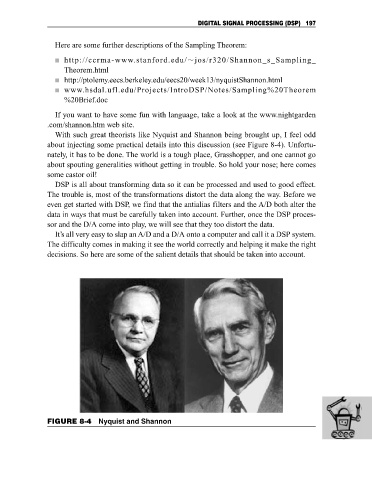
                              With such great theorists like Nyquist and Shannon being brought up, I feel odd
                            about injecting some practical details into this discussion (see Figure 8-4). Unfortu-
                            nately, it has to be done. The world is a tough place, Grasshopper, and one cannot go
                            about spouting generalities without getting in trouble. So hold your nose; here comes
                            some castor oil!
                              DSP is all about transforming data so it can be processed and used to good effect.
                            The trouble is, most of the transformations distort the data along the way. Before we
                            even get started with DSP, we find that the antialias filters and the A/D both alter the
                            data in ways that must be carefully taken into account. Further, once the DSP proces-
                            sor and the D/A come into play, we will see that they too distort the data.
                              It’s all very easy to slap an A/D and a D/A onto a computer and call it a DSP system.
                            The difficulty comes in making it see the world correctly and helping it make the right
                            decisions. So here are some of the salient details that should be taken into account.


                            FIGURE 8-4 Nyquist and Shannon

