


Page 244 - Anatomy of a Robot
P. 244
09_200256_CH09/Bergren   4/17/03  11:24 AM  Page 229
                                                                                  COMMUNICATIONS 229
                              Baseband transmission is used with many different types of media. Data transmis-
                            sion by wire has occurred since well before Napoleon’s army used the fax machine.
                            Yes, the  first  faxes  dropped  on  the  office  floor  about  that  time  in  history  (www
                            .ideafinder.com/history/inventions/story051.htm).
                              Baseband transmission is also used in tape drives and disks. Data is recorded as
                            pulses on tape and is read back at a later time.
                              A sequence of pulses can be constructed in many different ways. Engineers have nat-
                            urally come up with dozens of different ways these pulses can be interpreted. As is often
                            the case, other goals exist besides just sending as many bits per second across the chan-
                            nel as possible. However, in satisfying other goals, channel capacity is sacrificed. Here’s
                            a list of other goals engineers often have to solve while designing the way pulses are
                            put into a channel:

                                Direct Current (DC) balance  Sometimes the channel cannot transmit a DC
                                 voltage at all. A continuous string of all ones might simply look like a continu-
                                 ously high voltage. Take, for instance, a tape drive. The basic equation for voltage
                                 and the inductance of the tape head coil is


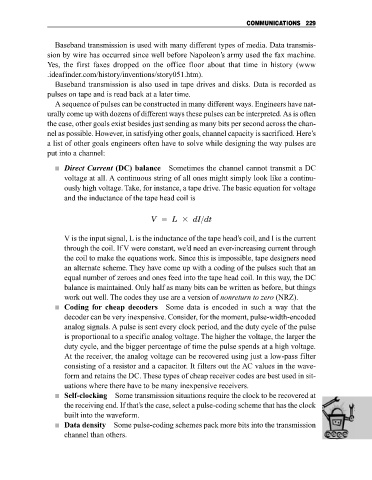
                                                        V     L     dI>dt

                                 V is the input signal, L is the inductance of the tape head’s coil, and I is the current
                                 through the coil. If V were constant, we’d need an ever-increasing current through
                                 the coil to make the equations work. Since this is impossible, tape designers need
                                 an alternate scheme. They have come up with a coding of the pulses such that an
                                 equal number of zeroes and ones feed into the tape head coil. In this way, the DC
                                 balance is maintained. Only half as many bits can be written as before, but things
                                 work out well. The codes they use are a version of nonreturn to zero (NRZ).
                                Coding  for  cheap  decoders  Some  data  is  encoded  in  such  a  way  that  the
                                 decoder can be very inexpensive. Consider, for the moment, pulse-width-encoded
                                 analog signals. A pulse is sent every clock period, and the duty cycle of the pulse
                                 is proportional to a specific analog voltage. The higher the voltage, the larger the
                                 duty cycle, and the bigger percentage of time the pulse spends at a high voltage.
                                 At the receiver, the analog voltage can be recovered using just a low-pass filter
                                 consisting of a resistor and a capacitor. It filters out the AC values in the wave-
                                 form and retains the DC. These types of cheap receiver codes are best used in sit-
                                 uations where there have to be many inexpensive receivers.
                                Self-clocking Some transmission situations require the clock to be recovered at
                                 the receiving end. If that’s the case, select a pulse-coding scheme that has the clock
                                 built into the waveform.
                                Data density Some pulse-coding schemes pack more bits into the transmission
                                 channel than others.

