


Page 364 - Anthropometry, Apparel Sizing and Design
P. 364
356                                     Anthropometry, Apparel Sizing and Design

         under elongation and methods of correction of the pattern blocks from loose shapes
         into tight-fitting shapes.
            Knitted materials have shrinkage (or edge curl). The amount of shrinkage is deter-
         mined by the material type, structure, processing technology, and finishing methods.
         Due to the laddering characteristic of the knitted materials, the seam allowance
         (including sewing loss) is usually 0.12–2.50cm. In order to obtain the necessary
         pressure on the shoulder area, the pattern block should be reduced by an average
         of 10% compared to the dimension, calculated for a rigid cylinder of the same size
         (Ng, 2001).
            When knitted material has good draping and little shrinkage, the length and
         width of the finished pressure garment will become longer and narrower. To get
         a desirable shape, the pattern block should be drawn with negative ease in the
         horizontal. When knitted material has poor draping and large shrinkage proper-
         ties, we need to increase the length in the vertical in the pattern block. To sum
         up, the pattern drawing rules should include edge size (seam allowance), sewing
         loss, horizontal ease, vertical shrinkage and other various shrinkages, etc.
         (Anbumani, 2007).
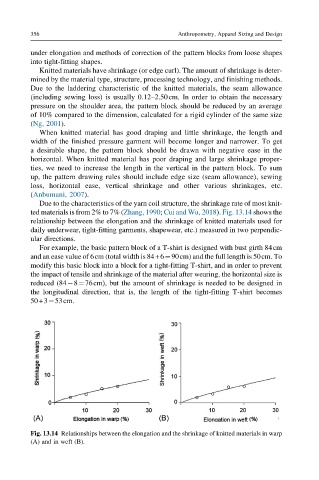
            Due to the characteristics of the yarn coil structure, the shrinkage rate of most knit-
         ted materials is from 2% to 7% (Zhang, 1990; Cui and Wu, 2018). Fig. 13.14 shows the
         relationship between the elongation and the shrinkage of knitted materials used for
         daily underwear, tight-fitting garments, shapewear, etc.) measured in two perpendic-
         ular directions.
            For example, the basic pattern block of a T-shirt is designed with bust girth 84cm
         and an ease value of 6cm (total width is 84+6¼90cm) and the full length is 50cm. To
         modify this basic block into a block for a tight-fitting T-shirt, and in order to prevent
         the impact of tensile and shrinkage of the material after wearing, the horizontal size is
         reduced (84 8¼76cm), but the amount of shrinkage is needed to be designed in
         the longitudinal direction, that is, the length of the tight-fitting T-shirt becomes
         50+3¼53cm.


         Fig. 13.14 Relationships between the elongation and the shrinkage of knitted materials in warp
         (A) and in weft (B).

