


Page 366 - Anthropometry, Apparel Sizing and Design
P. 366
358                                     Anthropometry, Apparel Sizing and Design


                             Female                      Male


                                                              Bust 18.5...21.0
                 25.0...31.3  Bust
                  7.0...12.2  Arm                             Arm 18.0...20.2
                 21.5...38.9  Waist                          Waist 17.7...20.4
                  5.5...16.4  Forearm
                                                           Forearm  16.8...18.9
                 25.0...25.2  High hip
                                                          Low waist  20.0...20.8
                 26.5...37.5 Hip
                                                               Hip  22.5...23.7
                 14.5...21.5  Thigh
                                                             Thigh  17.0...18.8
                 19.4...24.3  Midthigh
                                                          Midthigh
                 18.5...25.5  Knee                                17.0...18.8
                  8.0...17.0  Calf                             Calf  18.3...19.5
                  9.0...11.3  Ankle


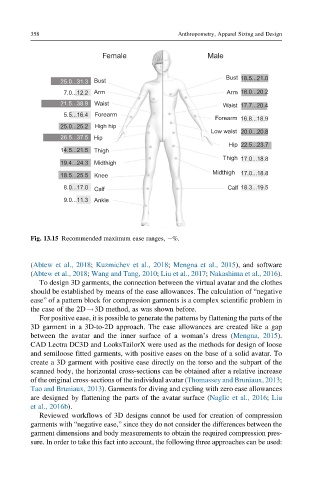
         Fig. 13.15 Recommended maximum ease ranges,  %.


         (Abtew et al., 2018; Kuzmichev et al., 2018; Mengna et al., 2015), and software
         (Abtew et al., 2018; Wang and Tang, 2010; Liu et al., 2017; Nakashima et al., 2016).
            To design 3D garments, the connection between the virtual avatar and the clothes
         should be established by means of the ease allowances. The calculation of “negative
         ease” of a pattern block for compression garments is a complex scientific problem in
         the case of the 2D!3D method, as was shown before.
            For positive ease, it is possible to generate the patterns by flattening the parts of the
         3D garment in a 3D-to-2D approach. The ease allowances are created like a gap
         between the avatar and the inner surface of a woman’s dress (Mengna, 2015).
         CAD Lectra DC3D and LooksTailorX were used as the methods for design of loose
         and semiloose fitted garments, with positive eases on the base of a solid avatar. To
         create a 3D garment with positive ease directly on the torso and the subpart of the
         scanned body, the horizontal cross-sections can be obtained after a relative increase
         of the original cross-sections of the individual avatar (Thomassey and Bruniaux, 2013;
         Tao and Bruniaux, 2013). Garments for diving and cycling with zero ease allowances
         are designed by flattening the parts of the avatar surface (Naglic et al., 2016; Liu
         et al., 2016b).
            Reviewed workflows of 3D designs cannot be used for creation of compression
         garments with “negative ease,” since they do not consider the differences between the
         garment dimensions and body measurements to obtain the required compression pres-
         sure. In order to take this fact into account, the following three approaches can be used:

