


Page 115 - Applied Process Design for Chemical and Petrochemical Plants Volume I
P. 115
102                      Applied Process Design for Chemical and Petrochemical Plants

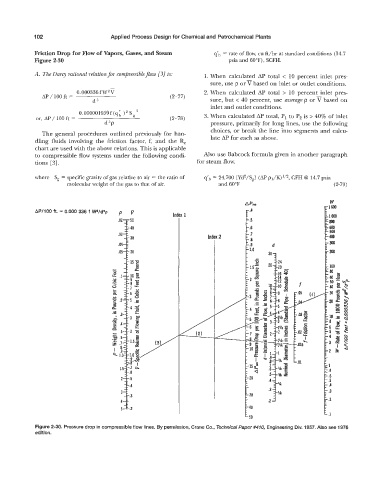
             Friction Drop for Flow of Vapors, Gases, and Steam         q'h  = rate of flow, cu ft/hr  at standard conditions (14.7
             Figure 2-30                                                     psia and 60"F), SCFH.

             A. The Darcy rational relation for compressible $ow  [3] is:   1. When  calculated  AP  total  < 10 percent  inlet  pres-
                                                                       sure, use p orv based on inlet or outlet conditions.
                           0.000336 f W'V                            2. When  calculated  AP  total  > 10 percent  inlet  pres-
               AP / 100 ft =                              (2-77)
                                d5                                     sure, but < 40 percent, use  average p orV based on
                           0.000001959f (q  )  S  '                    inlet and outlet conditions.
             or, AP / 100 ft =                            (2-78)     3. When calculated AP total, PI to P,  is > 40% of inlet
                                    d5p                                pressure, primarily for long lines, use the following
                                                                       choices, or break the line into segments and calcu-
               The general  procedures  outlined  previously for han-
             dling  fluids  involving the  friction  factor, f,  and  the  k   late AP for each as above.
             chart are used with the above relations. This is applicable
             to compressible flow systems under the following condi-   Also use Babcock formula given in another paragraph
             tions [3].                                           for steam flow.

             where  S,  = specific gravity of gas relative to air = the ratio of   q'h  = 24,700 [Yd2/S,]  (AP pl/K)'12,  CFH @ 14.7 psia
                       molecular weight of the gas to that of air.        and 60°F                              (2-79)


                                                                                  AP,,                         W
                                                                                                              1600
             APf100 ft.  = 0.000 336 f  Wz/dsp   P  V        tl                     .4                       i
                                                                                                              loOa
                                                                                    .5
                                                                                                              600
                                                                                    .6
                                            40                                     I                          8w
                                                                                                               500
                                            30                        Inc  2        .7                        100
                                                                                    .8
                                        .04                                         .9     d                  300
                                                                                    1.0
                                                                                          30 7                 200


                                                                                   r 40
                                                                                  E50
             Figure 2-30. Pressure drop in compressible flow lines. By permission, Crane Co., Technical Paper #474 Engineering Div. 1957. Also see 1976
             edition.

