


Page 318 - Applied Process Design for Chemical and Petrochemical Plants Volume I
P. 318
Mixing of Liquids                                      289


                                                                  I Blending lpro@ler
                                                                         Paddle  L

                                                                  I     ITank Vol. 1  - 1,000,000 Gols.1


              j       Key= --_                          1
                          --  Batch  Process
                       --
                               Continuous  Process
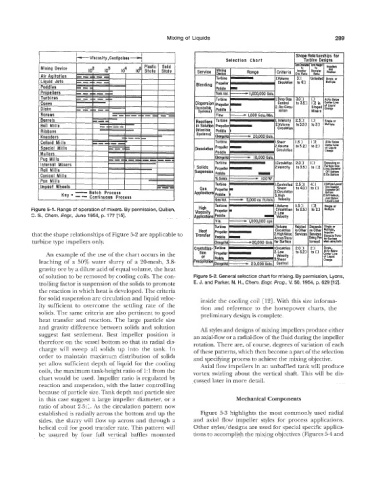
            Figure 5-1. Range of  operation of mixers. By permission, Quillen,
            C. S., Chem. Engp., June 6954, p. 177 1151.


            that the shape relationships of Figure 5-2 are applicable to
            turbine type impelllers only.
                An example of  the use of thle chart occurs in the
              leaching of  a 50% water  slurry  of  a 20-mesh, 3.8-
              gravity ore by a dilute acid of equal volume, the heat
              of solution to be removed by cooling coils. The con-   Figure 5-2. General selection chart for mixing.  y permission, Lyons,
              trolling factor k suspension of the solids to promote   E. J. and Parker, N. H., Chem. Engr. Prog., K 50,1954, p. 529 [I 21.
              the reaction in which heat is developed. The criteria
              for solid suspension are circulation and liquid veloc-   inside the cooling coil  [12]. With this size informa-
              ity  sufficient  to  overcome  the  settling rate  of  the   ti~n and  reference  to  the  horsepower  charts,  the
              solids. The same criteria are also pertinent to good   preliminary design is complete.
              heat  transfer  and reaction. The large  particle  size
              and gravity (difference between solids and solution   All styles and designs of mixing impellers
              suggest  fast  settlement.  Best  impeller  position  is   an axial-flow or a radial-flow of the fluid during the impeller
              therefore on the vessel bottom so that its radial dis-   rotation. There are, of course, degrees of variation of each
              charge  will  sweep  all  solids  up  into  the  tank.  In   of these patterns, which then become a part of the selection
              order to  maintain  maximum  distribution  of  solids   and speclfylng process to achieve the mixing objective.
              yet allow su-Cficient depth of  liquid for the  cooling   Axial flow impellers in an unbaffled tank will produce
              coils, the maximum tank-height ratio of 1:l from the   vortex swirling about the vertical shaft. Tinis will  be  dis-
              chart would be  used. Impeller ratio is regulated by   cussed later in more detail.
              reaction and suspension, with the latter controlling
              because of particle size, Tank depth and particle size
              in this case suggest a large impeller  diameter, or a             Mechanical Co
              ratio of  aibout 2 5:B. As the circulation pattern now
              established is saldiaUy across the bottom and up the   Figure 5-3 highlights the most commonly used radial
              sides, the  slurry will  flow up across  and through  a   and  axial  flow  impeller  styles  for  process  applications.
              helical coil for good transfer rate. This pattern will   Other styles/designs are used for special specific applica-
              be  assured  by  four  €dl vertical  baffles  mounted   tions to accomplish the mixing objectives (Figures  5-4 and

