


Page 331 - Applied statistics and probability for engineers
P. 331
Section 9-1/Hypothesis Testing     309


                                         Thus, in testing any statistical hypothesis, four different situations determine whether the i nal
                                         decision is correct or in error. These situations are presented in Table 9-1.
                                            Because our decision is based on random variables, probabilities can be associated with
                                         the type I and type II errors in Table 9-1. The probability of making a type I error is denoted
                                         by the Greek letter α.
                            Probability of
                             Type I Error                a = (type I error ) = (reject  H when  H is true )  (9-3)
                                                            P
                                                                          P
                                                                                           0
                                                                                   0
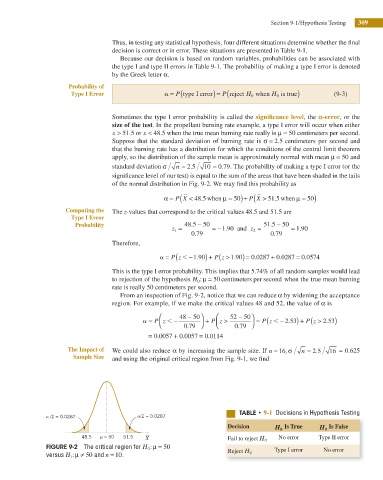
                                         Sometimes the type I error probability is called the signii cance level, the `-error, or the
                                         size of the test. In the propellant burning rate example, a type I error will occur when either
                                         x > 51 5 or x < 48 5 when the true mean burning rate really is μ = 50 centimeters per second.
                                              .
                                                        .
                                         Suppose that the standard deviation of burning rate is σ = 2 5  centimeters per second and
                                                                                           .
                                         that the burning rate has a distribution for which the conditions of the central limit theorem
                                         apply, so the distribution of the sample mean is approximately normal with mean μ = 50 and
                                         standard deviation σ  n  = .5  10  = .79. The probability of making a type I error (or the
                                                                2
                                                                         0

                                         signiicance level of our test) is equal to the sum of the areas that have been shaded in the tails
                                         of the normal distribution in Fig. 9-2. We may ind this probability as

                                                            P
                                                                                  P
                                                                    .5
                                                                                          .5
                                                         α = (X < 48 when  μ = ) + (X > 51 when  μ = )
                                                                              50
                                                                                                    50
                           Computing the   The z-values that correspond to the critical values 48.5 and 51.5 are
                             Type I Error
                                                                                         .
                              Probability                      48 5 −  50              51 5 −  50
                                                                 .
                                                           z 1 =       = − 1 90 and  z 2 =     =  1 90
                                                                                                 .
                                                                           .
                                                                 0 79                    0 79
                                                                                          .
                                                                  .
                                         Therefore,
                                                                           >
                                                                        P
                                                           P
                                                        a = (z  , −1 90 ) + (z 1 90.  ) = 0 0287.  + 0 0287  = 0 0574
                                                                                            .
                                                                                                   .
                                                                   .
                                         This is the type I error probability. This implies that 5.74% of all random samples would lead
                                         to rejection of the hypothesis H 0 : =  50 centimeters per second  when the true mean burning
                                                                    μ
                                         rate is really 50 centimeters per second.
                                            From an inspection of Fig. 9-2, notice that we can reduce α by widening the acceptance
                                         region. For example, if we make the critical values 48 and 52, the value of α is
                                                       ⎛     48  − 50 ⎞  ⎛   52  − 50 ⎞                > 2 5. 33)
                                                                                      P
                                                       ⎜
                                                                        ⎜
                                                  a = P z , −  0 79  ⎟ ⎠  + P z >  0 79  ⎟ ⎠  = (z  , −2 53.  ) + P z (
                                                       ⎝
                                                                        ⎝
                                                                               .
                                                                .
                                                    =  0 0057 +.  0 0057 =.  0 0114
                                                                      .
                            The Impact of   We could also reduce α by increasing the sample size. If n = 16 , σ  n = .5  16 = 0.625
                                                                                                     2
                               Sample Size  and using the original critical region from Fig. 9-1, we i nd
                                                                               5"#-& t 9-1  Decisions in Hypothesis Testing
                     a /2 = 0.0287               a/2 = 0.0287
                                                                            Decision      H 0  Is True  H 0  Is False
                                48.5  m = 50  51.5  X                       Fail to reject H 0  No error  Type II error
                     FIGURE 9-2  The critical region for H 0 :μ =  50                     Type I error   No error
                     versus H 1 :μ  ≠  50 and n = 10.                       Reject H 0

