


Page 334 - Applied statistics and probability for engineers
P. 334
312     Chapter 9/Tests of Hypotheses for a Single Sample


                                        0.8
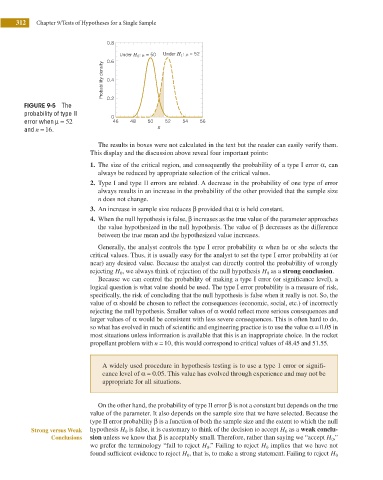
                                           Under H 0 : m = 50  Under H 1 : m = 52
                                        0.6
                                      Probability density  0.4


               FIGURE 9-5  The          0.2
               probability of type II    0
               error when μ = 52         46    48   50   52   54    56
               and n = 16.                             – x

                                     The results in boxes were not calculated in the text but the reader can easily verify them.
                                   This display and the discussion above reveal four important points:
                                   1.  The size of the critical region, and consequently the probability of a type I error α, can
                                     always be reduced by appropriate selection of the critical values.
                                   2.  Type I and type II errors are related. A decrease in the probability of one type of error
                                     always results in an increase in the probability of the other provided that the sample size
                                     n does not change.
                                   3.  An increase in sample size reduces β provided that α is held constant.
                                   4.  When the null hypothesis is false, β increases as the true value of the parameter approaches
                                     the value hypothesized in the null hypothesis. The value of β decreases as the difference
                                     between the true mean and the hypothesized value increases.
                                     Generally, the analyst controls the type I error probability α when he or she selects the
                                   critical values. Thus, it is usually easy for the analyst to set the type I error probability at (or
                                   near) any desired value. Because the analyst can directly control the probability of wrongly
                                   rejecting H 0 , we always think of rejection of the null hypothesis H 0  as a strong conclusion.
                                     Because we can control the probability of making a type I error (or signiicance level), a
                                   logical question is what value should be used. The type I error probability is a measure of risk,
                                   speciically, the risk of concluding that the null hypothesis is false when it really is not. So, the
                                   value of α should be chosen to relect the consequences (economic, social, etc.) of incorrectly
                                   rejecting the null hypothesis. Smaller values of α would relect more serious consequences and
                                   larger values of α would be consistent with less severe consequences. This is often hard to do,
                                   so what has evolved in much of scientiic and engineering practice is to use the value α = 0.05 in
                                   most situations unless information is available that this is an inappropriate choice. In the rocket
                                   propellant problem with n = 10, this would correspond to critical values of 48.45 and 51.55.


                                      A widely used procedure in hypothesis testing is to use a type 1 error or signii-
                                      cance level of α = 0.05. This value has evolved through experience and may not be
                                      appropriate for all situations.


                                     On the other hand, the probability of type II error β is not a constant but depends on the true
                                   value of the parameter. It also depends on the sample size that we have selected. Because the
                                   type II error probability β is a function of both the sample size and the extent to which the null
                 Strong versus Weak   hypothesis H 0  is false, it is customary to think of the decision to accept H 0  as a weak conclu-
                       Conclusions  sion unless we know that β is acceptably small. Therefore, rather than saying we “accept H 0 ,”
                                   we prefer the terminology “fail to reject H 0 .” Failing to reject H 0  implies that we have not
                                   found suficient evidence to reject H 0 , that is, to make a strong statement. Failing to reject H 0

