


Page 606 - Battery Reference Book
P. 606
Nickel-cadmium secondary batteries  56/43
      .-..                                        McGraw Edison
      -
      -
      W
      P 1.80
      >                                           This company produces three ranges of batteries:
      ;
        1.70
      -  1.60                                       The CED range for low-rate discharge applications
      5 1.50
      .- c" 1.40                                    such as communications standby systems.
        1.30                                        The  ED  and  MED  ranges  for  medium-rate  dis-
      E   0    1   2    3   4   5    6   7    8     charges in  applications, respectively, such as rail-
                                                    way  signalling, communications, rail  transit  (ED)
                                                    and switch gear power operations (MED).
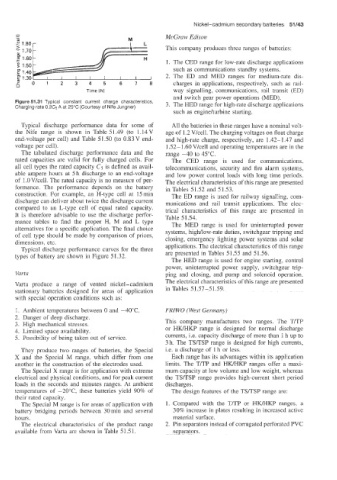
      Figure 51.3'1  Typical  constant  current  charge  characteristics.   The HED range for high-rate discharge applications
      Charging rate 0.2125  A at 25°C (Courtesy of Nife Jungner)
                                                    such as engine/turbine starting.
       Typical  discharge  performance  data  for  some  of   All the batteries in these ranges have a nominal voit-
      the  Nife  range  is  shown  in  Table 51.49  (to  1.14V   age of  1.2 Vkell. The charging voltages on float charge
      end-voltage per cell) and Table 51.50 (to 0.83V end-   and high-rate charge, respectively, are  1.42- 1.47 and
      voltage per cell).                          1.52- 1.60 V/cell and operating temperatures are in the
       The  tabulated  discharge performance  data  and  the   range -40  to 45°C.
      rated capacities are velid for fully charged cells. For   The  CED  range  is  used  for  communications,
      all cell types the rated capacity Cs is defined as avail-   telecommunications, security and fire  alarm systems,
      able ampere hours  at 5 h discharge to  an end-voltage   and low power control loads with long time periods.
      of  1 .O V/cell. The rated capacity is no measure of per-   The electrical characteristics of this range are presented
      formance.  The  performance  depends  on  the  battery   in Tables 51.52 and 51.53.
      construction.  For  example,  an  H-type  cell  at  15min   The ED range is used for railway signalling, com-
      discharge can deliver about twice the discharge current   munications  and  rail  transit  applications.  The  elec-
      compared  to  an  L-type  cell  of  equal  rated  capacity.   trical  characteristics  of  this  range  are  presented  in
      It  is  therefore  advisable  to  use  the  discharge perf'or-   Table 51.54.
      mance  tables  to  find  the  proper  H,  M  and  L  type   The  MED  range  is  used  for  unintenvpted  power
      alternatives for  a specific application. The final choice
      of  cell type should be made by  comparison of prices,   systems, higWlow-rate duties, switchgear tripping and
                                                  closing, emergency lighting power  systems and  solar
      dimensions, etc.                            applications. The electrical characteristics of this range
       Typical discharge performance curves for the three
      types of  batter,y are shown in Figure 51.32.   are presented in Tables 51.55 and 51.56.
                                                    The HED range is used for engine starting, control
                                                  power,  uninterrupted  power  supply,  switchgear  trip-
      Varta                                       ping  and  closing,  and pump  and  solenoid operation.
      Varta  produce  a  range  of  vented  nickel-cadmium   The electrical characteristics of this range are presented
      stationary batteries  designed  for  areas of  application   in Tables 51.57-51.59.
      with special operation conditions such as:
      1. Ambient temperatures between 0 and -40°C.   FRIWO (West Germany)
      2.  Danger of deep discharge.
      3.  High mechanical stresses.               This  company  manufactures  two  ranges.  The  TRP
     4.  Limited space availability.              or  HWHKP  range  is  designed  for  normal  discharge
      5.  Possibility of being taken out of  service.   currents, i.e. capacity discharge of more than 1 h up to
                                                  3 h. The TS/TSP range is designed for high currents,
       They  produce two ranges  of  batteries,  the  Special   i.e. a discharge of  1 h or less.
     X  and  the  Special  M  range,  which  differ  from  one   Each range has its advantages within its application
      another in the construction of the electrodes used.   limits.  The  T/TP  and  HWHKP ranges  offer a maxi-
       The Special X range is for application with extreme   mum capacity at low volume and low weight, whereas
     electrical and physical conditions, and for peak current   the  TS/TSP range provides high-current short period
     loads in the  seconds and minutes ranges. At ambient   discharges.
     temperatures  of  -2O"C,  these batteries yield  90% of   The design features of  the TS/TSP range are:
     their rated capacity.
       The Special M range is for areas of application with   1. Compared  with  the  T/TP  or  HK/HKP  ranges,  a
     battery bridging  periods  between  30 min  and  several   30% increase in plates resulting in increased active
     hours.                                         material surface.
       The  electrical  characteristics of  the  product  range   2.  Pin separators instead of corrugated perforated PVC
      available from Varta are shown in Table 51.51.   separators.

