


Page 184 - Bebop to The Boolean Boogie An Unconventional Guide to Electronics Fundamentals, Components, and Processes
P. 184
Memory dCs     165

                          RAM and ROM Architectures
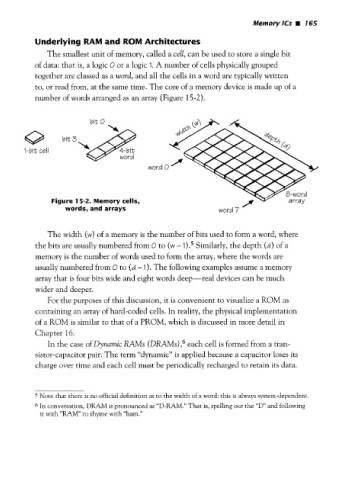
               The smallest unit of memory, called a cell, can be used to store a single bit
            of data: that is, a logic 0 or a logic 1.  A number of cells physically grouped
            together are classed as a word, and all the cells in a word are typically written
            to, or read from, at the same time. The core of a memory device is made up of a
            number of words arranged as an array (Figure 15-2).


                            bit 0

                    bit 3


                Figure 15-2. Memory cells,
                    wordst and arrays


               The width (w) of  a memory is the number of bits used to form a word, where

            the bits are usually numbered from 0 to (w -   Similarly, the depth (d) of a
            memory is the number of words used to form the array, where the words are
            usually numbered from 0 to (d - I).  The following examples assume a memory
            array that is four bits wide and eight words deep-real  devices can be much
            wider and deeper.

               For the purposes of this discussion, it is convenient to visualize a ROM as
            containing an array of hard-coded cells. In reality, the physical implementation
            of a RQM is similar to that of a PROM, which is discussed in more detail in


               In the case of Dynamic RAMS (DRAMS),‘ each cell is formed from a tran-
            sistor-capacitor pair. The term “dynamic” is applied because a capacitor loses its
            charge over time and each cell must be periodically recharged to retain its data.


            5 Note that there is no official definition as to the width of a word: this is always system-dependent.
            6 In conversation, DRAM is pronounced as “D-RAM.” That is, spelling out the “D” and following
             it with “RAM” to rhyme with “ham.”

