


Page 185 - Bebop to The Boolean Boogie An Unconventional Guide to Electronics Fundamentals, Components, and Processes
P. 185
166    Chapter Fifteen

              This operation, known as refreshing, requires the contents of each cell to be read
              out and then rewritten. Some types of  DRAM require external circuitry to
              supervise the refresh process, in which case a special independent controller
              device is employed to manage a group of DRAMS. In other cases, a DRAM
              may contain its own internal self-refresh circuitry.
                  In the case of Static RAMS (SRAMs) ,7  each cell is formed from four or six
              transistors configured as a latch or a flip-flop. The term “static” is applied
              because, once a value has been loaded into an SRAM cell, it will remain
              unchanged until it is explicitly altered or until power is removed from
              the device.
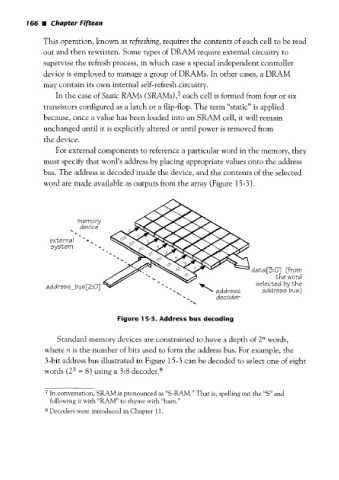
                  For external components to reference a particular word in the memory, they
              must specify that word’s address by placing appropriate values onto the address
              bus. The address is decoded inside the device, and the contents of the selected
              word are made available as outputs from the array (Figure 15-3).


                        memory
                       .
                         device
                              .
                external   ‘ .
                system


                                                                           data[3:0]  (from
                                                                                  the word
               address_bus[2:O]                                              selected by the
                                                         .       decoder
                                                                              address bus)


                                    Figure 15-3. Address bus decoding


                  Standard memory devices are constrained to have a depth of 2” words,
              where n  is the number of bits used to form the address bus. For example, the
              3-bit address bus illustrated in Figure 15-3 can be decoded to select one of eight
              words ( z3 = 8) using a 3:8 decoder.8


              7  In conversation, SRAM is pronounced as “S-RAM.” That is, spelling out the “S” and
                following it with “RAM” to rhyme with “ham.”
              8 Decoders were introduced in Chapter 11.

