


Page 190 - Bebop to The Boolean Boogie An Unconventional Guide to Electronics Fundamentals, Components, and Processes
P. 190
33


                 write-+'
                 - select


                                        data_bus[15:0] v


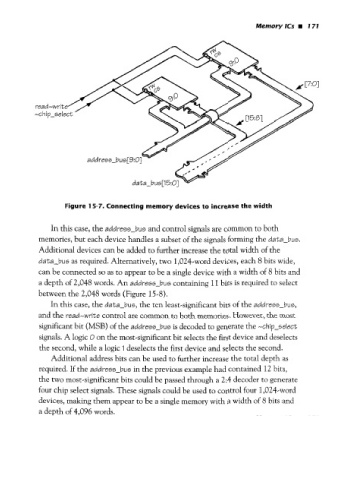
                    Figure 15-7. Connecting memory devices to increase the width


                In this case, the address-bus  and control signals are common to both
             memories, but each device handles a subset of the signals forming the data-bus.
             Additional devices can be added to further increase the total width of the
             data-bus  as required. Alternatively, two 1,024-word devices, each 8 bits wide,
             can be connected so as to appear to be a single device with a width of 8

             a depth of 2,048 words. An address-bus  containing 11 bits is required to select
             between the 2,048 words (Figure 15-8).

                In this case, the data-bus,  the ten least-significant bits of the address-bus,
             and the read-write  control are common to both memories. However, the most
             significant bit (MSB) of the address-bus  is decoded to generate the -chip-select
             signals. A logic O on the most-significant bit selects the first device and deselects
             the second, while a logic I  deselects the first device and selects the second.
                Additional address bits can be used to further increase the total depth as
             required. If the address-bus  in the previous example had contained 12 bits,
             the two most-significant bits could be passed through a 2:4 decoder to generate
             four chip select signals. These signals could be used to control four 1,024-word
             devices, making them appear to be a single memory with a width of 8 bits and
             a depth of 4,096 words.

