


Page 191 - Bebop to The Boolean Boogie An Unconventional Guide to Electronics Fundamentals, Components, and Processes
P. 191
7 72   Chapter Fifteen


         read -write


                        address-bus[lO:O]


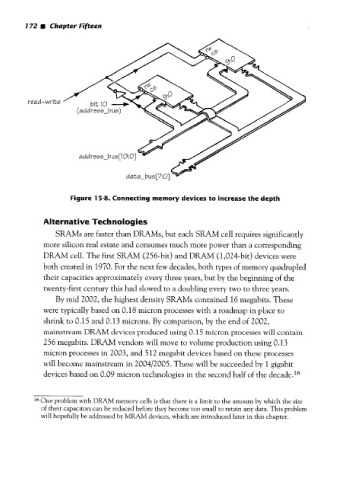
                      Figure 15-8. Connecting memory devices to increase the depth


              AI ternat ive Tech nolog ies
                 SRAMs are faster than DRAMS, but each SRAM cell requires significantly
              more silicon real estate and consumes much more power than a corresponding
              DRAM cell. The first SRAM (256-bit) and DRAM (1,024-bit) devices were
              both created in 1970. For the next few decades, both types of memory quadrupled
              their capacities approximately every three years, but by the beginning of  the
              twenty-first century this had slowed to a doubling every two to three years.
                 By mid 2002, the highest density SRAMs contained 16 megabits. These
              were typically based on 0.18 micron processes with a roadmap in place to
              shrink to 0.15 and 0.13 microns. By comparison, by the end of 2002,
              mainstream DRAM devices produced using 0.15 micron processes will contain
              256 megabits. DRAM vendors will move to volume production using 0.13
              micron processes in 2003, and 5 12 megabit devices based on these processes
              will become mainstream in 2004/2005. These will be succeeded by 1 gigabit
              devices based on 0.09 micron technologies in the second half of the decade.16


           16 One problem with DRAM memory cells is that there is a limit to the amount by which the size
             of their capacitors can be reduced before they become too small to retain any data. This problem
             will hopefully be addressed by MRAM devices, which are introduced later in this chapter.

