


Page 153 - Berkshire Encyclopedia Of World History Vol I - Abraham to Coal
P. 153
38 berkshire encyclopedia of world history


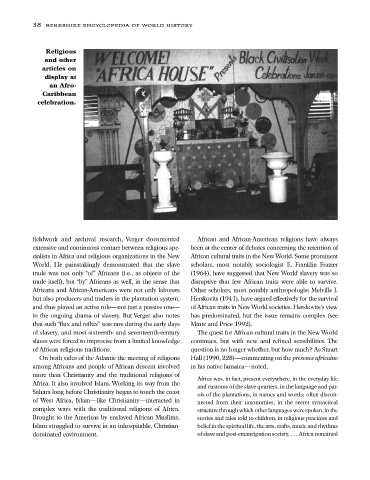
                Religious
                and other
               articles on
                display at
                 an Afro-
               Caribbean
             celebration.


            fieldwork and archival research, Verger documented     African and African-American religions have always
            extensive and continuous contact between religious spe-  been at the center of debates concerning the retention of
            cialists in Africa and religious organizations in the New  African cultural traits in the New World. Some prominent
            World. He painstakingly demonstrated that the slave  scholars, most notably sociologist E. Franklin Frazier
            trade was not only “of” Africans (i.e., as objects of the  (1964), have suggested that New World slavery was so
            trade itself), but “by” Africans as well, in the sense that  disruptive that few African traits were able to survive.
            Africans and African-Americans were not only laborers  Other scholars, most notably anthropologist Melville J.
            but also producers and traders in the plantation system,  Herskovits (1941), have argued effectively for the survival
            and thus played an active role—not just a passive one—  of African traits in New World societies. Herskovits’s view
            in the ongoing drama of slavery. But Verger also notes  has predominated, but the issue remains complex (see
            that such “flux and reflux” was rare during the early days  Mintz and Price 1992).
            of slavery, and most sixteenth- and seventeenth-century  The quest for African cultural traits in the New World
            slaves were forced to improvise from a limited knowledge  continues, but with new and refined sensibilities. The
            of African religious traditions.                    question is no longer whether, but how much? As Stuart
              On both sides of the Atlantic the meeting of religions  Hall (1990,228)—commenting on the presence africaine
            among Africans and people of African descent involved  in his native Jamaica—noted,
            more than Christianity and the traditional religions of
                                                                  Africa was, in fact, present everywhere, in the everyday life
            Africa. It also involved Islam. Working its way from the
                                                                  and customs of the slave quarters, in the language and pat-
            Sahara long before Christianity began to touch the coast
                                                                  ois of the plantations, in names and words; often discon-
            of West Africa, Islam—like Christianity—interacted in  nected from their taxonomies, in the secret syntactical
            complex ways with the traditional religions of Africa.  structure through which other languages were spoken,in the
            Brought to the Americas by enslaved African Muslims,  stories and tales told to children, in religious practices and
            Islam struggled to survive in an inhospitable, Christian-  belief in the spiritual life,the arts,crafts,music and rhythms
            dominated environment.                                of slave and post-emancipation society.... Africa remained

