


Page 166 - Berkshire Encyclopedia Of World History Vol I - Abraham to Coal
P. 166
age stratification 51


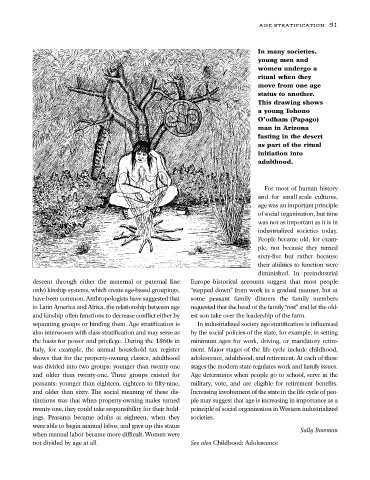
                                                                                      In many societies,
                                                                                      young men and
                                                                                      women undergo a
                                                                                      ritual when they
                                                                                      move from one age
                                                                                      status to another.
                                                                                      This drawing shows
                                                                                      a young Tohono
                                                                                      O’odham (Papago)
                                                                                      man in Arizona
                                                                                      fasting in the desert
                                                                                      as part of the ritual
                                                                                      initiation into
                                                                                      adulthood.


                                                                                        For most of human history
                                                                                      and for small-scale cultures,
                                                                                      age was an important principle
                                                                                      of social organization, but time
                                                                                      was not as important as it is in
                                                                                      industrialized societies today.
                                                                                      People became old, for exam-
                                                                                      ple, not because they turned
                                                                                      sixty-five but rather because
                                                                                      their abilities to function were
                                                                                      diminished. In preindustrial
            descent through either the maternal or paternal line  Europe historical accounts suggest that most people
            only) kinship systems, which create age-based groupings,  “stepped down” from work in a gradual manner, but at
            have been common.Anthropologists have suggested that  some peasant family dinners the family members
            in Latin America and Africa, the relationship between age  requested that the head of the family “rest” and let the old-
            and kinship often functions to decrease conflict either by  est son take over the leadership of the farm.
            separating groups or binding them. Age stratification is  In industrialized society age stratification is influenced
            also interwoven with class stratification and may serve as  by the social policies of the state, for example, in setting
            the basis for power and privilege. During the 1860s in  minimum ages for work, driving, or mandatory retire-
            Italy, for example, the annual household tax register  ment. Major stages of the life cycle include childhood,
            shows that for the property-owning classes, adulthood  adolescence, adulthood, and retirement.At each of these
            was divided into two groups: younger than twenty-one  stages the modern state regulates work and family issues.
            and older than twenty-one. Three groups existed for  Age determines when people go to school, serve in the
            peasants: younger than eighteen, eighteen to fifty-nine,  military, vote, and are eligible for retirement benefits.
            and older than sixty. The social meaning of these dis-  Increasing involvement of the state in the life cycle of peo-
            tinctions was that when property-owning males turned  ple may suggest that age is increasing in importance as a
            twenty-one, they could take responsibility for their hold-  principle of social organization in Western industrialized
            ings. Peasants became adults at eighteen, when they  societies.
            were able to begin manual labor, and gave up this status
                                                                                                    Sally Bowman
            when manual labor became more difficult.Women were
            not divided by age at all.                          See also Childhood; Adolescence

