


Page 169 - Berkshire Encyclopedia Of World History Vol I - Abraham to Coal
P. 169
54 berkshire encyclopedia of world history


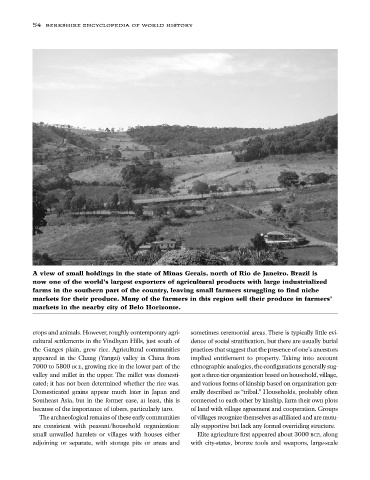
            A view of small holdings in the state of Minas Gerais, north of Rio de Janeiro. Brazil is
            now one of the world’s largest exporters of agricultural products with large industrialized
            farms in the southern part of the country, leaving small farmers struggling to find niche
            markets for their produce. Many of the farmers in this region sell their produce in farmers’
            markets in the nearby city of Belo Horizonte.


            crops and animals. However, roughly contemporary agri-  sometimes ceremonial areas. There is typically little evi-
            cultural settlements in the Vindhyan Hills, just south of  dence of social stratification, but there are usually burial
            the Ganges plain, grew rice. Agricultural communities  practices that suggest that the presence of one’s ancestors
            appeared in the Chang (Yangzi) valley in China from  implied entitlement to property. Taking into account
            7000 to 5800 BCE, growing rice in the lower part of the  ethnographic analogies,the configurations generally sug-
            valley and millet in the upper. The millet was domesti-  gest a three-tier organization based on household,village,
            cated; it has not been determined whether the rice was.  and various forms of kinship based on organization gen-
            Domesticated grains appear much later in Japan and  erally described as “tribal.” Households, probably often
            Southeast Asia, but in the former case, at least, this is  connected to each other by kinship, farm their own plots
            because of the importance of tubers, particularly taro.  of land with village agreement and cooperation. Groups
              The archaeological remains of these early communities  of villages recognize themselves as affiliated and are mutu-
            are consistent with peasant/household organization:  ally supportive but lack any formal overriding structure.
            small unwalled hamlets or villages with houses either  Elite agriculture first appeared about 3000 BCE, along
            adjoining or separate, with storage pits or areas and  with city-states, bronze tools and weapons, large-scale

