


Page 193 - Berkshire Encyclopedia Of World History Vol I - Abraham to Coal
P. 193
78 berkshire encyclopedia of world history


                                                                           There is no such thing as an inevitable war.
                                                                          If war comes it will be from failure of human
                                                                         wisdom. • Andrew B. Law (1858–1923)


                                                                and secured his appointment as hegemon (“leader”) of the
                                                                Corinthian League and commander in the war against
                                                                Persia. With his power base secure, Alexander crossed
                                                                into Asia in spring 334 BCE at the head of an army of
                                                                approximately 35,000 men.
                                                                  During the next decade Alexander campaigned as far
                                                                as western India before being compelled by a mutiny of
                                                                his army to return to the west, where he died in Babylon
                                                                in June 323 BCE.This remarkable campaign divides into
                                                                three distinct phases. The first phase, which lasted from
                                                                334 BCE to 330 BCE, is known as the “Greek Crusade”
                                                                and was marked by the great set battles of Granicus,
                                                                Issus, and Gaugamela and climaxed with the destruction
                                                                of the Persian capital of Perepolis and the assassination
                                                                of the Persian king Darius III by his own officers.The sec-
                                                                ond phase, which lasted from 330 BCE to 327 BCE,saw
                                                                Alexander adopt various aspects of Persian royal cere-
                                                                monial and practice despite Macedonian and Greek
                                                                opposition in order to attract Iranian support in the face
                                                                of fierce guerrilla resistance in central Asia.The third and
                                                                final phase of the campaign began with the two years
                                                                that Alexander spent in India and ended with his disas-
                                                                trous return to the west through Baluchistan and his
                                                                death in Babylon, while planning further campaigns,
                                                                beginning with an invasion of Arabia.
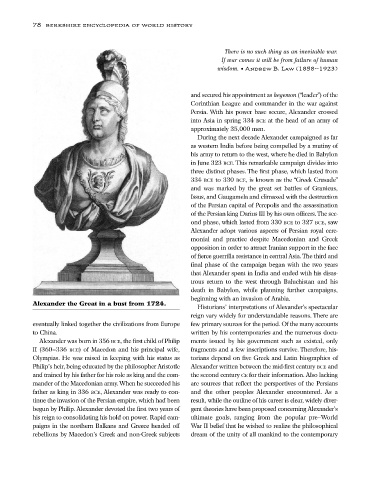
            Alexander the Great in a bust from 1724.
                                                                  Historians’ interpretations of Alexander’s spectacular
                                                                reign vary widely for understandable reasons. There are
            eventually linked together the civilizations from Europe  few primary sources for the period. Of the many accounts
            to China.                                           written by his contemporaries and the numerous docu-
              Alexander was born in 356 BCE, the first child of Philip  ments issued by his government such as existed, only
            II (360–336  BCE) of Macedon and his principal wife,  fragments and a few inscriptions survive. Therefore, his-
            Olympias. He was raised in keeping with his status as  torians depend on five Greek and Latin biographies of
            Philip’s heir, being educated by the philosopher Aristotle  Alexander written between the mid-first century BCE and
            and trained by his father for his role as king and the com-  the second century CE for their information.Also lacking
            mander of the Macedonian army.When he succeeded his  are sources that reflect the perspectives of the Persians
            father as king in 336 BCE, Alexander was ready to con-  and the other peoples  Alexander encountered. As a
            tinue the invasion of the Persian empire, which had been  result, while the outline of his career is clear, widely diver-
            begun by Philip.Alexander devoted the first two years of  gent theories have been proposed concerning Alexander’s
            his reign to consolidating his hold on power. Rapid cam-  ultimate goals, ranging from the popular pre–World
            paigns in the northern Balkans and Greece headed off  War II belief that he wished to realize the philosophical
            rebellions by Macedon’s Greek and non-Greek subjects  dream of the unity of all mankind to the contemporary

